 A talented soloist with self-deprecating humor, humble honesty and electric jumps on stage, Maria Bulanova is in-demand for roles like Myrtha, Kitri, Gamzatti and Firebird. Recently she debuted in the crowning role of the classical repertoire, that of Odette-Odile in “Swan Lake” which denotes her path to the top. Read about her unique path to the Mariinsky Theatre below, or find the original Russian text of this interview on this page.
Your family isn’t from the ballet world, how did you start dancing?
My parents are both connected to the world of biology: no one in my family is even from the theatrical field. It was completely by chance that Dad took me to the Nutcracker on New Year’s Eve. We had to give Mom time to prepare for the holiday, and she sent us to a performance at the Children’s Ballet School. I really liked it. Fortunately, the school was close to home. The performance was given by children, which interested me very much. I thought it would be great to dance too. Before that, I had attended dance classes, gymnastics, choir, and various clubs for general development. In the end, I traded all of these classes for ballet school, which, in principle, I don’t regret. The school was unusual in that there was stage practice from a very young age, it was an exceptional option for a private educational institution in the years prior to first grade at that time – you could not just study, but also be on stage.
Four years later, I entered the Vaganova Academy, studied there for one year, not very successfully, was expelled and returned to my ballet school, where I continued to study for several more years. This experience is certainly very useful, it left a certain imprint in the form of my own hasty conclusions that I was probably not suitable for this profession, and it was not worth hoping much for a successful result.
So I studied at Vladislav Kuramshin’s ballet school until I was 14, and then I had to decide urgently on my career choice (if it was to be ballet). Since my parents both come from the world of biology, they talked a lot about this profession, and I thought I’d follow in their footsteps. Due to the fact that ballet classes took up a lot of time, I couldn’t afford to seriously study chemistry or biology. I’d already realized that time was probably lost, I needed to try and do everything I’d begun so far, and complete it, and if it didn’t work out, then go on quietly and study.
So, at the age of 14, I went back to additional enrollment at the Vaganova Academy. Fortunately, I was accepted despite the fact that I was from a private school and lagged behind in many ways. I will never tire of thanking the rector of the Academy for such a chance, it was a great happiness for me and my parents. At that moment, I understood I needed to take a responsible approach to studying at the Academy, because he gave me, an unknown girl with dubious prospects, a big gift.
Why did you decide to return there when you were 14?
I had begun to grow up. When I was 11 years old and had to attend the Academy, I didn’t understand why. It was so much fun at my ballet school, and we went on stage in performances… And there at the Academy you had to stand at the barre and do tendus, this routine seemed unbearably boring to me, and most importantly, incomprehensible. Of course, I regretted it 10 times later when I caught up with the program at an older age. But I don’t regret it now, because I learned some lessons for myself. Besides, if I had done otherwise, it’s not a fact that I would have ended up with Ludmila Valentinovna Kovaleva, whom I love very much. I was fantastically lucky that she was recruiting a class that year. I remember Ludmila Valentinovna looked at me and said, “Well, your eyes are beautiful, let’s try,” and she accepted me. I studied with her for 3 years, then I came to the theater.…
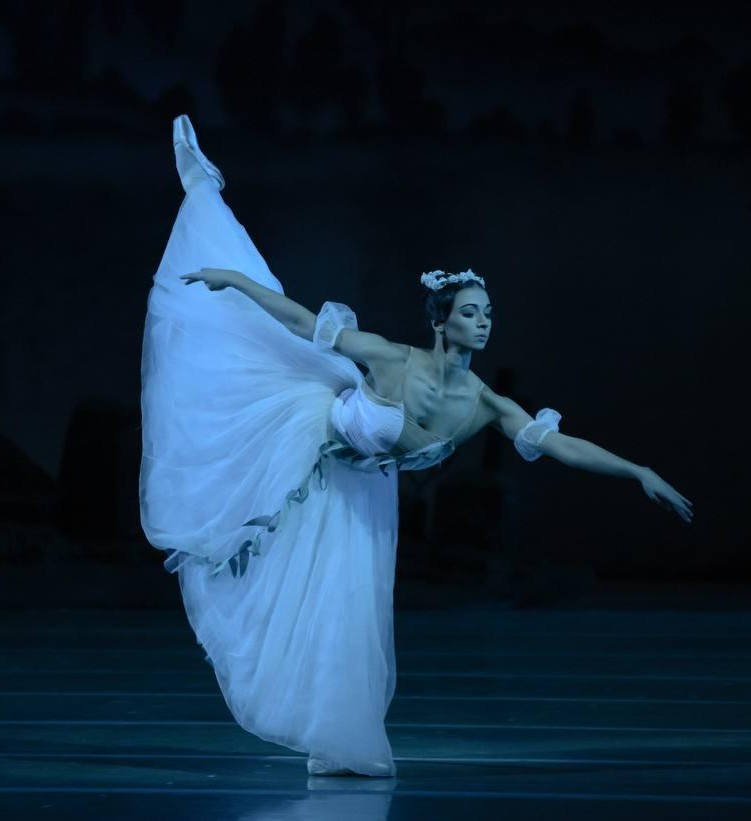 What were your feelings at that moment: you are in the last 3 courses at Vaganova Academy, but as a new student?
It was difficult for me, of course, I had to catch up, but that was my problem. It was most difficult for my teachers, who had to spend a lot of time on me. Because in the school where I studied before, there were no character, duet, or historical dance classes. It was very difficult with character dance, because there are specific movements and coordination in this subject. To be honest, it wasn’t easier with the classics, because I could do some movements – I was just well–trained – but it took time and attention to learn how to move correctly and beautifully, to dance smoothly, with the right academic coordination. I had to slowly “chew” each movement, as we say, and they had to explain it on their fingers, point by point, so that I would first understand how to do it with my head first, and then try to train my body to do it. And this above all demanded Ludmila Valentinovna’s time and nerves. The first year was the most difficult. Then it became easier.
Was there a sense of competition?
For several months, my eyes were racing around, I didn’t understand what to grab onto. At that moment, there was no question of competition for me, because I realized that I was lagging far behind. Ludmila Valentinovna wanted us to learn to analyze ourselves, and we often learned from each other. She would point at someone and ask: “Are they doing it right or wrong?” Therefore, our sense of each other was strongly developed. I don’t know if you can call it competition or not, but we watched each other very closely. Again, Ludmila Valentinovna always said: “It is very important to look at your friends and learn from your friends too.” We had a pretty friendly class, and we still communicate.
You have very strong jumps and turn well. It’s hard to believe that these big moments were difficult for you at the Academy. When I enrolled [in the Academy], I turned the same way I do now. Maybe even better. It was fortunate that we were taught to turn quite early, when there were no sudden growth spurts (which are most often associated with great difficulties in coordination), and, most importantly, there was no fear. At the age of 10, I was already turning well. I think it’s easier to learn at that age, even if you look at our ice skaters, they master the technique and then try to keep it. It’s probably easier than studying as an adult. I’m not sure. My two wonderful colleagues, with whom I studied at the Academy in childhood, Ksenia Zhiganshina (Bolshoi Theater) and Lada Sartakova (Primorsky Stage of the Mariinsky Theater), turn perfectly, from which I conclude that, probably, our teacher at school did the right thing. Thanks goes to Ludmila Valentinovna for jumps. In general, I think a woman’s jump is in many ways the right use of coordination, because we don’t have as much muscle strength as men, and we need to approach these things wisely and make the most of the physics that we are given. Ludmila Valentinovna taught this seriously and for a long time, she analyzed every moment, she made us watch recordings of adult dancers in slow motion to see at what point the impact occurs. It’s hard for me to say, I can’t compare myself to someone with different traits, but it’s definitely a matter of coordination. I’ve been taught this for quite a long time.
Are you still in touch with her?
Yes, we’re still in touch, we’re pretty close. I recently visited her on the occasion of her anniversary, I really love going to her classes, just to chat, to watch the learning process and remember what it was like.
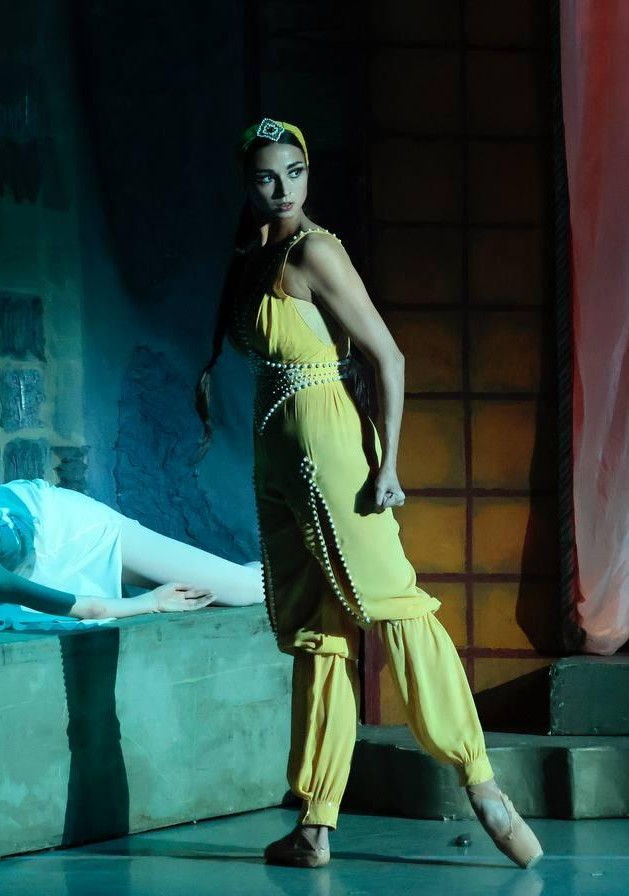 During your second year at the Academy, you performed at the Vaganova Grand Prix (2016). What kind of experience did it give you?
The competition was in October, and I didn’t think I’d be accepted, but Ludmila Valentinovna wanted everyone to try. The very process of competitions was not new to me. This fear is incomparable when you enter the competition. It’s not as scary to simply go onstage. It was clear to me that everything was going to shake, my knees, etc. And the preparation… I worked on the variation with Kovaleva, it was great, we would rehearse 4 hours a day, and when she worked with you on the variation alone, one-on-one, it’s a completely different experience than taking class. For many dancers, this was their first solo work. I realized that in order for something to work out, you have to work hard. I also realized that Ludmila Valentinovna felt sorry for me and took care of me during the first year of my studies, but our serious work began at the competition. And it was a good step for me to have a little confidence in myself. I still have photos of me and the girls standing backstage at the Hermitage Theater with scared eyes – it’s funny. Fear brings you very close when you’re afraid of something together.
Did you think of joining the Mariinsky Theatre?
I wasn’t thinking about the Bolshoi or the Mariinsky at all. My fate developed spontaneously. I’d been thinking for a long time whether to go into ballet or not. And when I decided, I had so many immediate tasks to solve just to stay in school, to catch up with the program. I didn’t even look forward one year, because there was so much to do. But my thoughts were, “I don’t think they’ll take me here at all,” and was just hoping they would not expel me. This is, of course, another feature of youth, when there are a lot of emotions but a lack of rationality. In my senior year, when they started watching us, for some reason I didn’t take it seriously, I don’t know why. I understood that I needed to pass the state exam well and dance well at graduation performances. Then, when the problem of choosing a company arose, I was very puzzled. I had to choose between the Bolshoi and the Mariinsky. And if I didn’t think much about the Mariinsky, then I really had not thought about the Bolshoi at all, it seemed to me that it was another universe. As a result, I decided to stay in St. Petersburg.
But there were auditions …
That also happened suddenly! Unfortunately, I didn’t think about it. Due to the fact that the commission is selected for the state exams and invited to another viewing here in the theater. But we went to Moscow in honor of Petipa’s anniversary, and Makhar Khasanovich Vaziev saw us at the Bolshoi. He watched the concert and came to watch our class, this was actually the audition, but I didn’t know that at the time. It turns out, he invited me to join the Bolshoi earlier than the Mariinsky extended their invitation. Of course, this messed up my cards a lot, I didn’t know what to do. I wasn’t ready for this! And until the last moment I thought: “I’m going to Moscow.” But the repertoire here (at the Mariinsky) is the best that could be, and it’s native to me. Naturally, Ludmila Valentinovna and all the teachers at the Academy lived and grew up on this repertoire, and we were trained on it, so I became especially attached to this theater. But there was a portion of adventurism in me, I didn’t fully weigh the pros and cons, I realized I wouldn’t be able to calculate everything. And I realized that I was just doing what I wanted to do. (It was like I was in kindergarten!) My whole career has been like this. Funny. My parents, of course, pushed me to decide. If it wasn’t for them, I probably wouldn’t have decided to enroll in the Academy a second time.
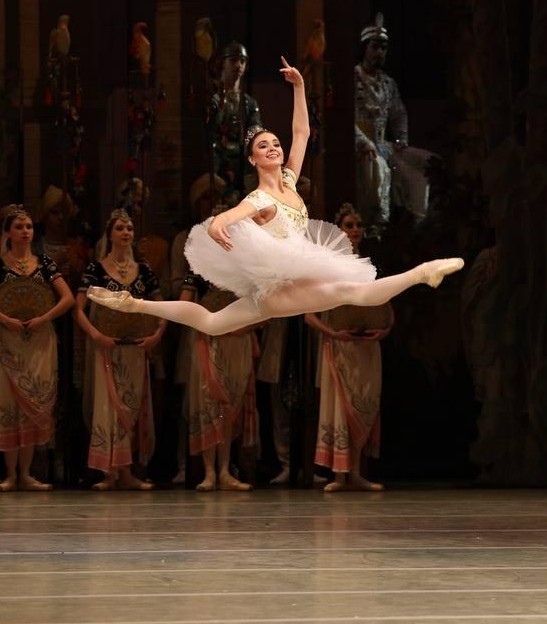 Was some adaptation required during your first season in the theatre?
Of course some adaptation was necessary, some people need it moreso than others. First of all, you have to master the repertoire. It’s one thing to watch from the audience but another thing altogether to learn the roles and start to perform them. There’s a huge volume of information and work to absorb and that’s always a challenge. The absence of classes and lessons was unusual. We were already learning directly during the rehearsal process. But it was successfully arranged in that students graduate at the end of June, work for a month, and then at the beginning of the season they return to work in the theatre at least slightly adapted. The first 3 weeks before the vacation, we tried to figure out where we were, and then we had a vacation to learn some of the things we were told and returned more or less adequate.
Do you have a specific pedagogue in the theatre?
Yes, Elena Viktorovna Evteeva. I met her in the summer when I started working in the theatre. Everyone has a close relationship with their pedagogues for the classical repertoire, and switching to new hands is a serious step, we need to get used to each other for awhile.
How does she differ from Kovaleva?
It’s worth starting, in principle, with the fact that the work of a pedagogue in the theatre is different from the work of a teacher in school. At first, of course, it was unusual for me. I think Ludmila Valentinovna is probably choleric, she’s emotional and loud in the studio, she’s active. The message and intonation in the voice are very readable, especially when we’re little, and it often seems to me that children primarily feel not the meaning of the phrase, but its emotional message. For me that was unusual at first. Elena Viktorovna is a very intelligent, calm person, but her discipline in rehearsals is perhaps even stricter than Ludmila Valentinovna’s, or to say it more precisely, they have different rules. In short, I had to grow up. There’s a book called “Games People Play” by Eric Berne, I love it very much, it describes various patterns of human behavior in communication, and one of these models is “Adult with adult” (we rationally and intelligently solve the issues that need to be solved, without emotions). It seems to me that such communication was built by Elena Viktorovna. In school, of course, they’re tasked with educating us and preparing us for adulthood.
You have “tall” roles like Myrtha (typically danced by taller girls) but also technical roles like Gamzatti and Kitri. Do you have an emploi?Of course, in ballet there are types –like being typecast—and emploi, and it would be ridiculous to say I can try to dance in La Sylphide, naturally I’m not suitable for it. I have certain parameters based on which a suitable repertoire for me is chosen. Naturally, when I was still in school, I watched “Giselle” (Myrta) and “La Bayadere” (Gamzatti) with great trepidation. I didn’t think about “Rubies” then, I wouldn’t have had enough fantasies to imagine myself in it. But I got lucky. Of course I wanted to dance “Don Quixote”, but it’s like that… I remember that more often than not I turned on “La Bayadere” and watched a recording with Tatiana Gennadievna Terekhova performing Gamzatti. Ludmila Valentinovna always said, “Open your eyes and look!” That’s very useful.
Many tall girls love adagio. Is it easier for you to dance allegro or adagio? Definitely allegro. Compared to adagio, jumping is a rest for me. People are different. My mother was very muscular, she practiced swimming in her youth, and after many years she was very strong physically. Maybe I was lucky with my muscles, because height of course does not really contribute to the speed of movement (if we’re talking about allegro). But adagio is a nightmare for me, it’s terrible, and that’s no secret.
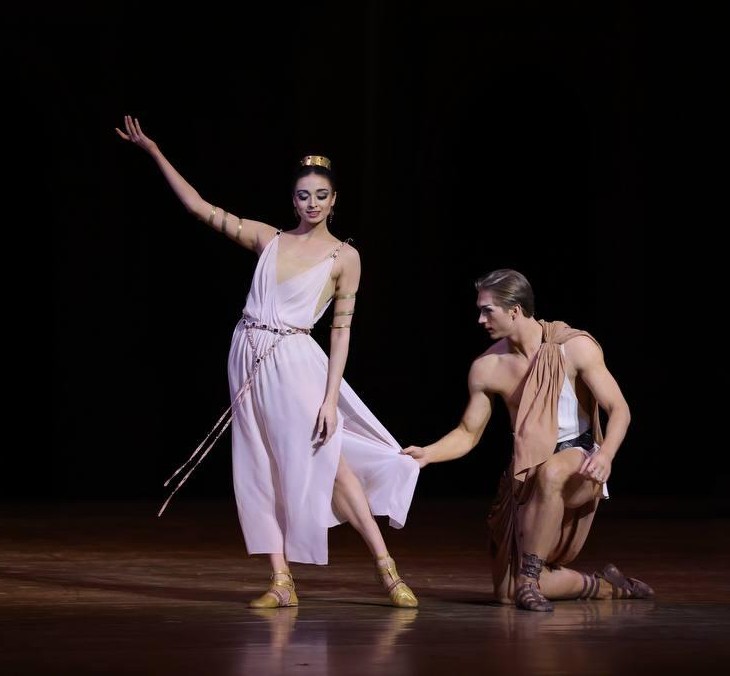 Did anything change after you became a soloist besides the roles?
I was promoted to soloist a year and a half after graduating from the Academy, and before that, of course, I was in the corps de ballet. We had a happy opportunity to try ourselves in quartets, trios, and at the same time prepare solo parts. I can’t say that I shone in the corps de ballet, alas, more often I likely caused problems for colleagues and pedagogues, constantly getting out of line or out of rhythm. It’s a very hard and difficult job, the corps de ballet, and I did not work there very long. So in fact, not much has changed for me with the transition, but of course, I was very pleased with the promotion.
Do you do any cross–training?
During the quarantine (Covid) I did various sorts of interval and cardio workouts. Later I started to work with a sports doctor, and I’ve been working for the past five years with his advice and help, which I’m very happy about. I really love Pilates, there’s a studio near the theatre which is convenient, I’ve gone there periodically for many years.
Do you have to follow a diet?
Yes, that’s my problem, my Achilles heel. The boys lift us. It’s one thing when you injure yourself but another when you might injure your partner. As it is, I’m 1 meter 75 cm tall. From childhood I knew that I’d have to watch my weight. My mom is half Armenian and half Azerbaijani. My grandmother was Armenian, grandfather Azerbaijani. My mom was sturdy and I resemble her a great deal in my figure.
Is there a role that you’d like to dance?
I try not to think about it. In principle, over time what I want from this profession has changed. I’ve been thinking about it seriously for a long time and I try to look at it not from the point of view of the quantity or variety of performances I dance, but from the point of view of the content of my performances … although it would be stupid to negate the thought that expanding one’s repertoire always brings us joy. But fundamentally it’s not so important which production it is, it’s far more important what I can do in it. If you take any production, you can endlessly analyze it and reveal something new for yourself each time, and that’s incredible. I think it’s that way in any art form.
Is there any ballet you’d like to return to the repertoire that was previously performed here or that hasn’t yet been performed here?
I’d be happy if the ballets by George Balanchine returned to the repertoire and one of my favorite productions “In the Night” by Jerome Robbins, a wonderful, delicate production. Cranko’s “Onegin” too of course, at the Academy we all loved that ballet, but that’s just a dream.
What’s your favorite part of your job?
We’re all kind of adrenaline junkies, and I’m really happy when I manage to do what I demand of myself or when I’m in the process, have set a goal for myself for a production or during rehearsals, and if I manage to do it and then come home, I feel light in my soul. That’s really pleasant. I won’t lie, and say that I love coming to class each morning, warming up and doing adagio! But it’s worth staying without this daily fuss. And as for the performances, everything has its own charm: setting out the makeup, starting to do your makeup, warming up, coming on stage an hour before the start, when no one is there, the scenery has already been set up and everything is ready, and all that remains is for people to come and the lights to turn on. There’s also happiness hidden in those small moments. Pouring yourself a cup of coffee, starting to do your foundation makeup. There are these sorts of… I won’t call them “rituals” exactly, but daily routines that hold their own sort of wonder.
Are you superstitious? I was for a very long time: I had to put my right pointe shoe on first and the left second, and lots of stupid things that I thought up myself. But it became too much and at one point I understood that I’d go crazy if I keep doing all of these things. They distract from work. I understood that they really hold no relationship too the work and I had to stop them. And I understand people who do them, to some degree they are soothing rituals. But when it’s over the top, that’s not good. To knock on the stage, cross yourself, jump up and down – I stopped doing that because I understood that I look like an idiot.
Do you believe in God?
I think I do. But for me, religion was always like a moral guideline. Of course I believe, but to not to call myself a “believer”, would not be correct. Let’s just say I’m on the path.
What about belief in Fate?
Unequivocally. Too many twists and turns. There have been things that cannot be explained otherwise than by Fate.
What’s the hardest part of your job?
As in real life, not only for dancers, being honest with yourself, not deceiving yourself. If you deceive yourself, you deceive others. On stage you cannot do that. On stage we are like in the palm of someone’s hand, people look at us and everything is visible – your flaws, your sins, all of it. You have to be honest, without question. I think that I have made some viewers happy, I hope!
Have you had any strange experiences on stage?
Oh yes! That’s legendary. In “La Sylphide”, I was Effy, James’ fiancée. It so happened that I stumbled and fell right on my bottom during the peak of the first act, right in the middle of the stage. (Editor’s note: from the recording it looks like it’s out of the blue). In fact, my leg just caught on the boy‘s leg. You could say it was an accident, I didn‘t really blame myself. But this, of course, is a disgrace, it seemed to me that it lasted forever!
What does the Mariinsky Theatre mean to you?
I try to think about it this way… it would sound grandiose to say a “temple of art” but it’s a specific place, an institution that I truly respect and love, and I’m so glad I’ve become a part of it, and that it holds a large place in my life. Of course I began here when I was 17 years old, and at that time it was my entire life. But we grow up, and at some point I understood that it’s harmful when the theatre is your entire life, and it’s harmful above all for work in the theatre because you slowly start to accept what happens with an inadequate perception and inappropriate understanding of yourself – you have to evolve in a balanced manner, and in the first order for the stage that’s helpful. Of course we all love the theatre and without it, it’s like being without water. It’s something innate to us. I often tell myself that you need to love and respect the theatre, I don’t know how much that happens in reality.
Do you have any advice for young people who would like to start ballet and become professionals? I’m not someone who should give advice since my own path is still questionable! But above all – strength. Believe in yourself, do not deceive yourself, and love what you do. If you truly genuinely love it and you’re interested in it, then there will always be a happy union. If not, then it’s easy to let it go and follow your dream. Do not make a tragedy out of failures or become overjoyed by some successes because everything changes quickly. And to the mothers out there I wish you strength and patients. Mothers are saints.
Do you have a dream?
I’ve tried my entire life not to look into the future or guess about what may come. Maybe this is prosaic, but I try not to dream about anything. I’m happy that we have today and I hope for a good “tomorrow”. So I don’t have any demands.
Do you believe ballet will live on?
I think so. It will live on for the next 100 years. A visual art and its aesthetic components are always interesting to people. Then we’re also a musical theatre. It’s another question how it will develop and transform. In my view, we’re now at a turning point, and we need to look at what’s happening in the world’s theatres in order to be aware of and fully understand the situation. Where we will go stylistically over the next decade will be interesting to see. But Petipa’s traditions are very important, there must be a place where his productions are preserved and may that place be here, at the Mariinsky.
All photos courtesy of Maria Bulanova’s personal archive. With special thanks to the Mariinsky Press Office for their assistance.