 The White Nights Festival –two months saturated with performances that run daily on 3 stages simultaneously– offers viewers their choice of ballet, opera or symphonic works. It opened this year with “Swan Lake” featuring the remarkable debut of rising soloist Maria Bulanova (see our interview with her here), and in the opera world, the premiere of the new version of “Boris Godunov” by Bulgarian Orlin Anastasov, an experienced former opera singer in his own right who knows the work inside and out, and now brings his experience to the director’s chair.
Though only half the festival has passed, the ballet stage has already unveiled a fresh mixed bill: “Les Sylphides”, Leonid Jakobson’s “Brilliant Divertissement”, and Roland Petit’s famed “Le Jeune Homme et La Mort“. The latter two are stage premieres, with “Homme“ revived especially for the Mariinsky after a lapse in rights. Luigi Bonino rehearsed the casts first in silence—true to the original—then with Bach’s Passacaglia in C Minor. Happily, the new agreement secures a five-year run, giving local audiences ample opportunity to see this landmark work.
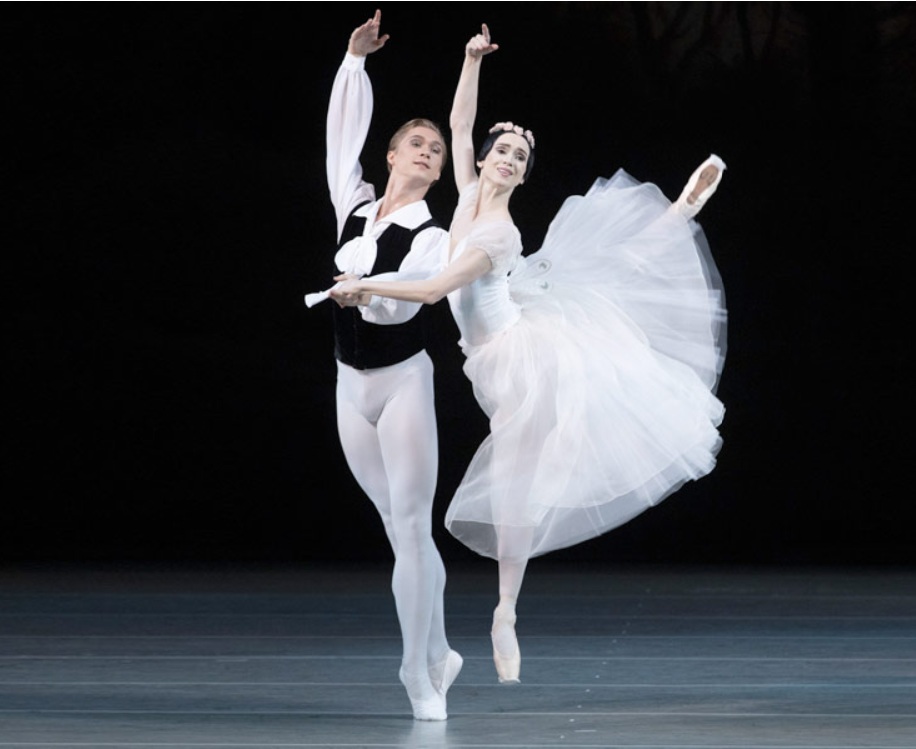
But first, the Chopin favorite. On June 20, Mikhail Fokine’s iconic “Chopiniana” (known in the West as “Les Sylphides”) featured a seamless cast: Anastasia Lukina and Nikita Korneev as the lead couple, Alisa Barinova in the 11th Waltz, and Kristina Shapran debuting in the Prelude. The calf-length tulle skirts—standard in the 19th century, once risqué for revealing ankles and feet (short tutus didn’t appear until the 1930s)—lent an ethereal visual that captures the era’s literary obsession with otherworldly spirits. Who better than Mariinsky soloists to embody these ephemeral beings? As the principal sylph, Lukina’s musicality shone, lifting her to a new lightness. Shapran delivered a delicate, coolly elusive sylph in the Prelude, her port de bras steeped in soulful longing. Barinova, despite a professed love for allegro, embodied a sprightly nymph, exquisitely filling the adagio and radiating pure joy (see our interview with Barinova here). Korneev—tall, with classical port de bras and airy cabrioles—was every inch the romantic prince, a powerful partner and an idyllic Poet. The vision of a young man surrounded by weightless sylphs, perhaps born of his own imagination, comes alive at the Mariinsky, where every corps tendu aligns at the same angle, every head tilts to the exact degree. “Chopiniana” may not be fiery, but achieving this lightness eludes most companies. The Mariinsky, however, performs it in Fokine’s spirit, on Petipa’s foundations, with a visual polish unmatched worldwide in the Fokine tradition
Jakobson’s “Brilliant Divertissement” is no gala medley of excerpts. Rather, it’s a single, brisk composition—a blitz-ballet—featuring five couples led by a master of ceremonies. Men in velvet waistcoats and ribboned ponytails resemble 1700s chevaliers; women’s sparkling short tutus mirror the men’s colors. The effect is a peek into Louis XIV’s ballroom on a gala night. But Jakobson’s choreography departs significantly from choreographic tradition: classically based yet non-intuitive, its step sequences challenge Petipa’s foundations. Open fourth positions begin and end each section (rather than the proper closed croisé), men carry the prima with her legs bent, swivel turns and piqué arabesques with crossed front arms abound. These sequences lend a neoclassical flair and mine the possibilities within Glinka’s score. Yaroslav Baybordin, as the master of ceremonies, ushered in the dancers with a broad smile, warm demeanor, and smooth jumps. Valeria Kuznetsova, with Guillem-like feet and endless lines, excelled as the lead ballerina, ably supported by Yaroslav Borovitsky’s steady partnering. At one point, all five men held her aloft in a series of horizontal arabesque flips, while not a limb of hers touched the floor.
Among the other soloists featured, Yana Peneva turned her short variation into a playful study in musicality and expression. Deliciously precise, Peneva knows how to expand and contract movements along with the music to lend emphasis wherever wanted or needed, a highly coveted professional trait already visible in this young soloist. As her partner, Roman Malishev’s handsome looks, noble demeanor and smooth partnering led one to wonder if he was actually a prince on loan from another century for an hour. Alisa Barinova, seemingly tireless after her appearance in Sylphides just moments prior, proved sprightly and accurate alongside Kian Manghise, her partner, who executed flawless double tours facing upstage, each ending with a swivel. Recently promoted, Manghise has grown enormously as an artist in recent years. Daria Ionova’s lovely lines complemented Roma Gudelev’s firm grasp of the intricate choreography; Vlada Borodulina and Egor Rachin rounded out the group with strong chemistry. All displayed stunning technical mastery in this often bewildering choreography. “Divertissements” is a brisk foray into Jakobson’s world, and one worth seeing.
The unexpected return of “Le Jeune Homme et La Mort” delighted audiences no less than the dancers. More than one viewer (this one included) felt déjà vu watching Alexei Orokhovsky debut as the Homme—a role that echoes the late Vladimir Shklyarov, not in characterization but in sheer impact. From certain angles, the young dancer resembles his predecessor; in his jumps, he seems to levitate rather than push off, there is no visible propulsion, no takeoff point. His interpretation was vulnerable, a young man caught off-guard by the aggressive approach of La Mort, the woman in yellow. Stripped of vulgarity and steeped in sincerity, Orokhovsky’s performance incited both goosebumps and tears at once. Yet the similarities to Shklyarov end at emotional resonance. Orokhovsky’s deep humility, innate morality, and positive spirit are a refreshing presence in Petersburg’s star-studded ballet scene. His “La Mort” was the blossoming Maria Bulanova—tall, slender, and beautiful, she easily embodied the temptress, whether blowing smoke in his face or pounding the table. Elusive, seductive, and ultimately irresistible, she follows the libretto to its fatal end. Despite the ballet’s brevity, the lasting impression left by these two impossibly young rising stars attests to the deep talent within the Mariinsky ranks—and the urgent need to return to the theater for more.