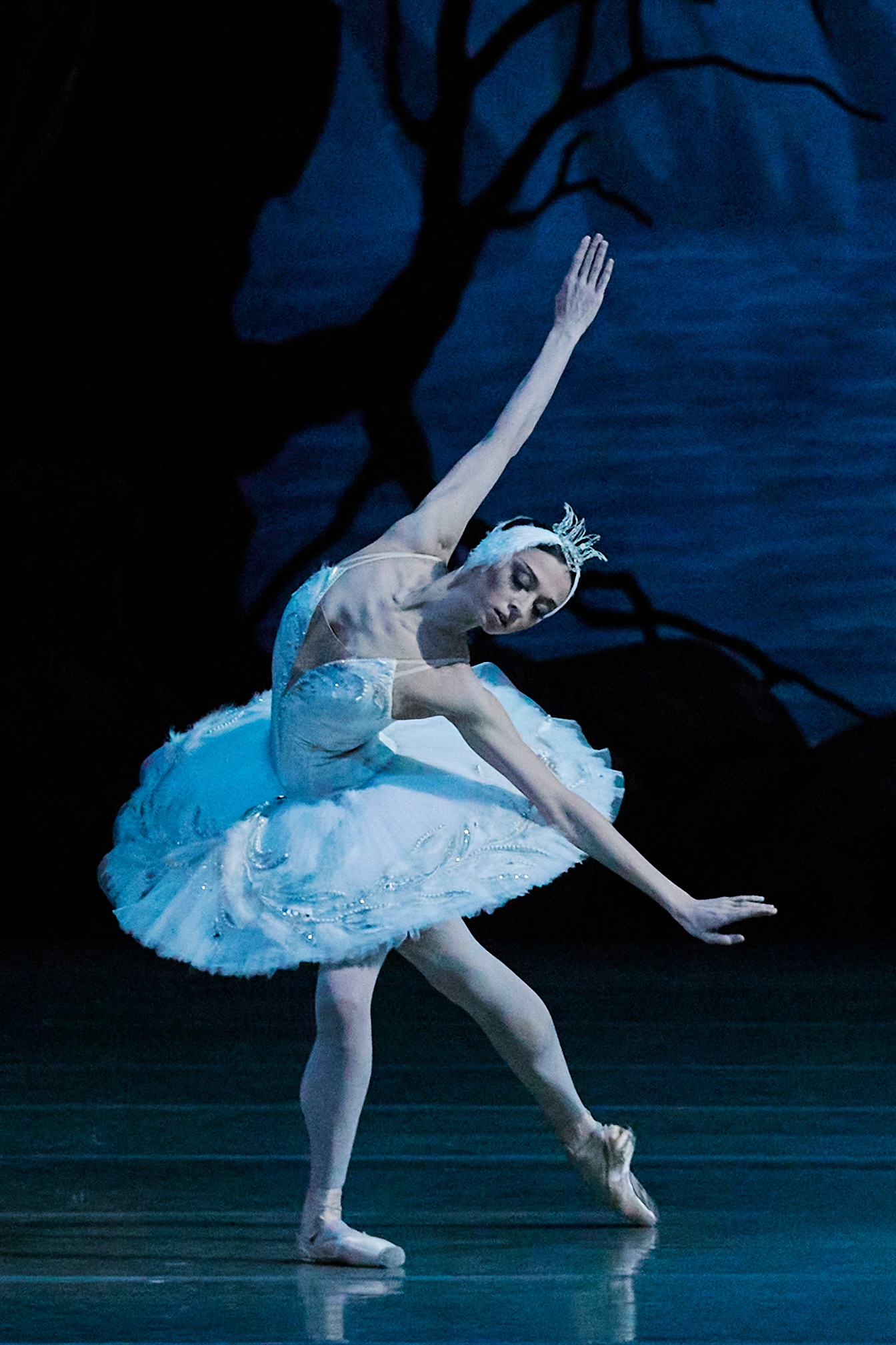
 When the White Nights Festival opened in May 2026, one particular debut hinted at a very bright future for one ballet soloist. Maria Bulanova reprised the role of Odette/Odile a second time in early July, and the results proved spectacular.
At 175 cm, this frank, hard-working ballerina might not have been the typical choice for “Swan Lake”. With long limbs, an easy jump, and a penchant for quick, plentiful turns, Bulanova is perhaps best described as a “tall Kitri”, filled with spice from her Armenian-Azerbaijani parents, and grace from years, of course, at the ballet barre. She is an iconic Gamzattii, a refined Lilac Fairy and her endless balances mean that legato roles, despite not being her preference, are nonetheless roles at which she excels. For more on her background, see our interview with her here.
Indeed, in recent decades the aesthetic for “Swan Lake” has shifted considerably from the compact ballerinas of the 1940s. Now long, slender lines take precedence, and with the progression of technique, dancers are expected to somehow enhance technical elements. Given the challenge of completing 32 fouettés, some dancers are lucky to just get through the sequence without stopping early or travelling too far across stage. Others have the basics and the talent to take it one step further. Simply based on physics, in order to turn, you need a stable point of balance and a clear sense of axis. Bulanova has both, enabling not just plentiful pirouettes at breakneck speeds, but lingering balances in arabesques or other transitional poses held longer than usual. This gift allows her to further personalize a given musical sequence, extending it as she displays that balance in a hovering shift or prolonged pose.
So if during the coda of the White Swan solo, her batterie in the entrechat quatre sequence served as a statement of sharp insistence and steely determination, a maiden caught in a Swan’s body desperate to escape, then the tender embraces and closing pirouette of the same duet showed the fluid grace and sensitivity of her character. Her Odile displayed the opposite set of traits, showing that, in dramatic terms, Bulanova can turn on the acting charm in both directions: from a gentle swan to an assured, wicked temptress with movements that match the characteristics of the role. Her Odile proved to be a resolute, alluring seductress, tantalizing not just with gesture and glance but with the very dance she performed. 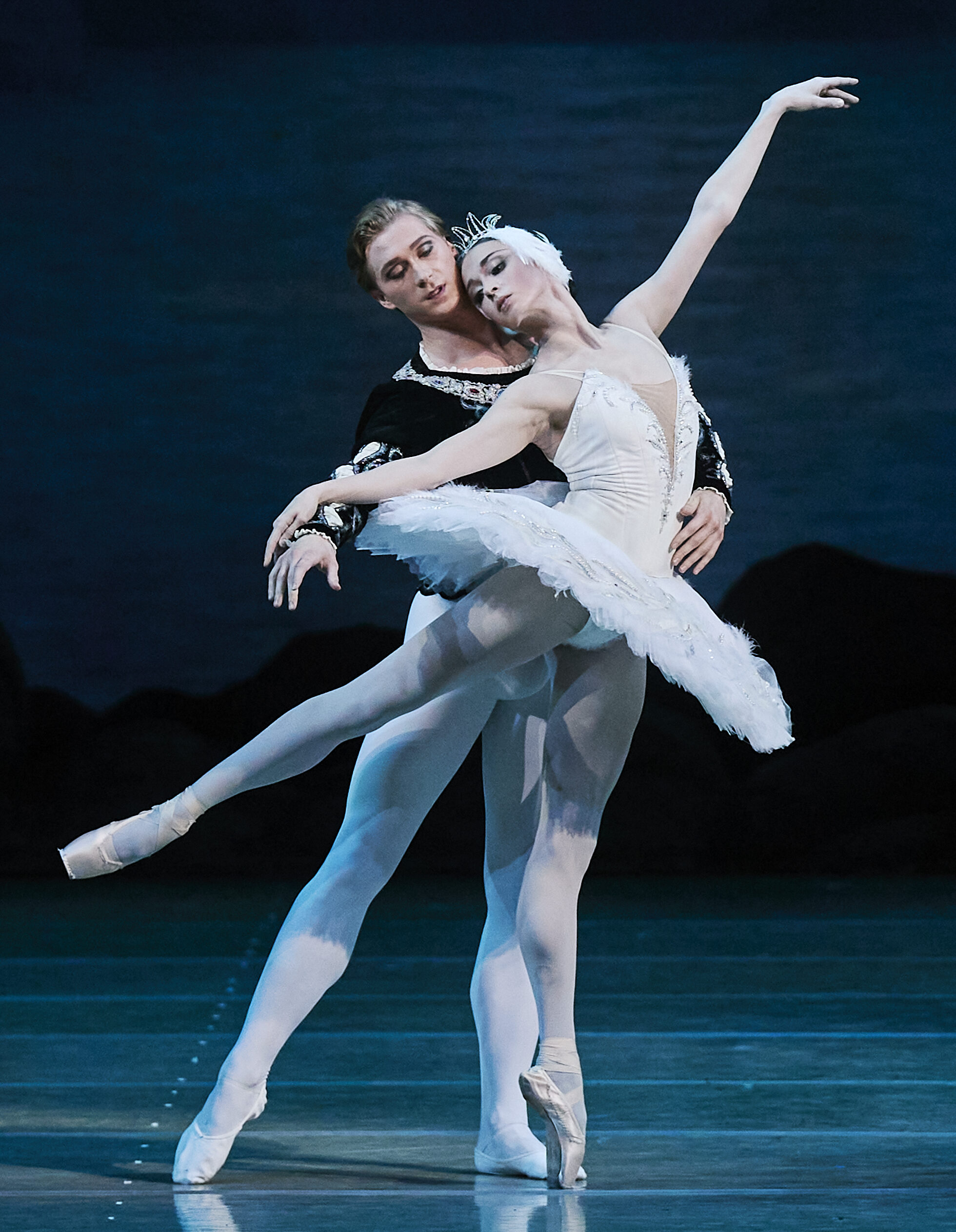 Triple pirouettes leading to triples in attitude began her Act 2 variation and hit a note of the highest virtuosity; no one else in the troupe can perform this many revolutions consistently, but they’re her signature. This was one performance when the audience interrupted the silence to applaud her midway through the solo. Nothing like this has been done before. Further underscoring that strength, her fouettés included consistent double turns throughout; the first sixteen counts alternated the doubles with turns holding the working leg à la seconde (requiring utter strength in the hip and thigh) with both arms up before pulling back into another double. She performed the full set of 32 at an unusually swift tempo.
Her Siegfried, Nikita Korneyev, is the go-to partner this season as many principals and soloists have been unfortunately sidelined with injuries. Dependable partnering served as the basis for amplified dramatic delivery – clearer than usual gestures and facial expressions supplemented his pantomime sections, proving that often a higher dose of acting can round out a character, raising it from simple performance to something greater.
As Rothbart, Ruslan Steniushkin’s quick head movements and stern gestures embodied the all-powerful wizard responsible for the mess in the libretto. Despite being the role we love to despise, Steniushkin infused his work with professional timing and nuanced accents, especially in the Black Act when indicating Siegfried must swear eternal love, and not just propose marriage to Odile. With roles increasingly bestowed upon him, Steniushkin has risen to the occasion more than once this past season.
In Act 2’s character dances, several soloists drew attention for fiery technique and bright expression. Nail Enikeev, now an audience favorite for his deep talent in dramatic roles such as Espada, Hans/Hilarion, Tybalt and the like, performed a spicy Spanish duet alongside the gorgeous Olga Belik, a beauty both onstage and off.
A lovely surprise came in Alexander Wunder’s performance as the lead soloist in the Hungarian dance alongside Evgenia Savkina who is now a routine, vibrant fixture in most character dance roles. Savkina’s mastery easily melds with almost any partner. Alongside Wunder, who inherited his father’s dark locks and his mother’s beauty (Maya Dumchenko was a beloved Kirov/Mariinsky soloist for decades), the two made a handsome couple in this stylized section. Wunder clearly has the talent of a ballet dynasty in his blood: statuesque with ideal proportions and innate musicality, he’ll be one to watch as the years pass. For now, he’s completing his second season with the company.
As the Act 3 solo swans, Camilla Mazzi danced a delicate, emotional, tender variation, alluding to the possibility she might one day be cast in the leading role. Veselina Ilieva danced equally accurately. Throughout the afternoon, Andrey Ivanov conducted a pleasantly strident orchestra in the historical orchestra pit, without the sound loss that often occurs in the newer Mariinsky-2 building. The winds and percussion instruments in particular emanated a high-level energy that matched that on stage, for which gratitude goes to both conductor and musicians.
The White Nights Festival will soon draw to a close for 2026, but Maria Bulanova will return to the stage this fall in the new season. If you have a chance to watch her in “Swan Lake”, she guarantees not only a dazzling performance but a promising and long future on the Mariinsky stage.
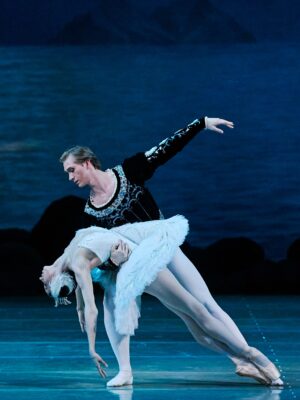
All photos (c) 2026 Mariinsky Theatre by Mikhail Vilchuk.