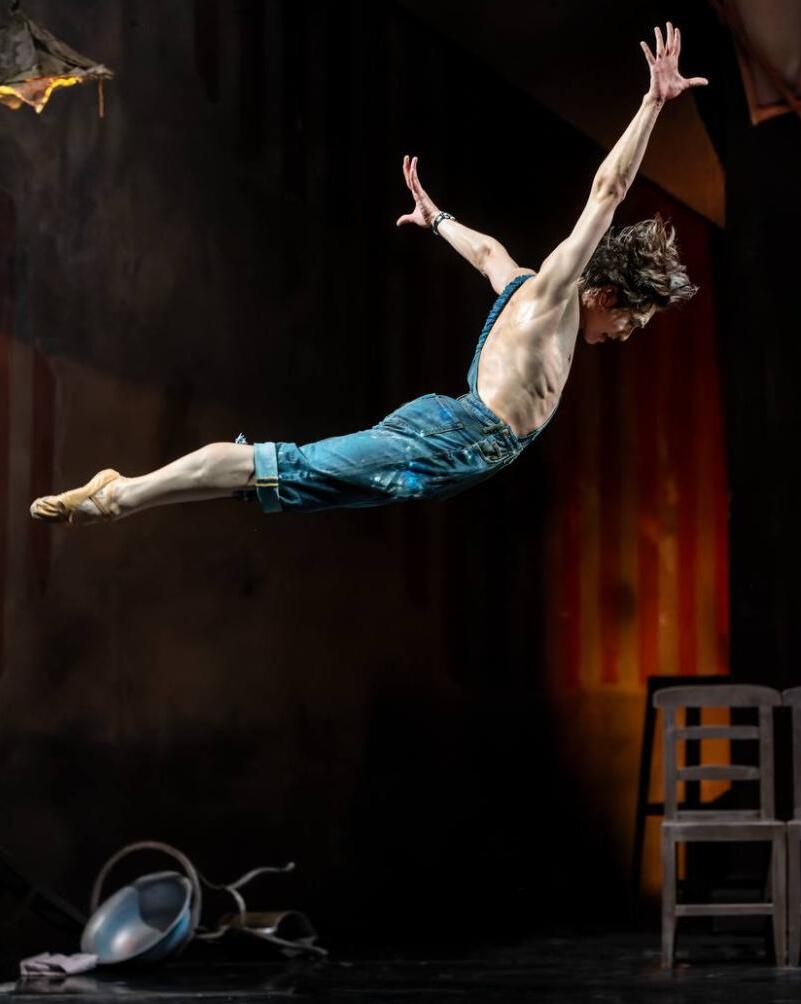
Following the triumphant results of the 2026 Moscow International Ballet Competition, a trio of brilliant soloists from the Mariinsky Theatre, all of whom studied at the John Cranko Academy in Stuttgart, Germany, were honored with promotions from second soloist to first soloist. Among these outstanding dancers is Ryoma Hudzeleu, who won the gold medal in the Men’s solo category. Vaganova Today had the honor of speaking with Ryoma, sharing the joy of his recent victory and discussing his path to St. Petersburg. The original Russian of this interview can be found on this page.
You have a unique background, please tell us how you got started in the world of ballet?
Both of my parents are ballet dancers. My father worked at the National Bolshoi Theatre of Belarus in Minsk. After four years in the theater, he went to Japan, where he met my mother. My mother studied in France with Rosella Hightower, returned to Japan and danced in various theaters.
 With both parents in ballet, was it your choice to dance?
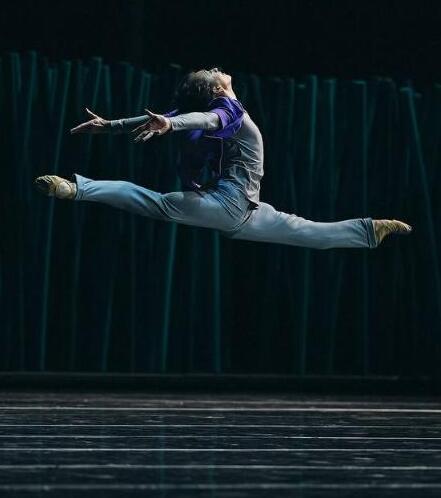
Not at first. My parents wanted me to study to become a ballet dancer. Since they had their own private studio, I started dancing at the age of three. I would go to their studio, watch their classes and sometimes I performed at private concerts. When I was 11 years old, my mother suggested I participate in a competition. Not as big as the international ones, but it was held in Japan. I performed several times and met a good friend there, someone with whom I’m still friends. I guess that’s why I became more interested in ballet. Then when I was 12 years old, I entered the school in Minsk, where my dad had studied. Before Covid, I spent a year and a half there. During the quarantine, I returned to Japan, and later, when I was 15 or 16 years old, I returned to Minsk. At that moment, my traits, extension and turnout were not developed so I started stretching more seriously. I had to perform Solor’s variation and demonstrate my extension in the performance. So through daily stretching, I achieved more turnout and improved my extension
You first competed at YAGP in Barcelona in 2022, as I understand?
Yes. The people who work at YAGP suggested that I change schools to become even better. At that moment, representatives from the John Cranko school offered me an internship at their school. I didn’t immediately agree. There was a problem after the competition in Minsk with my teacher. I didn’t prepare for the competition with him because he was always busy with other lessons, but he didn’t like that I attended the competition, apparently. He had worked with Igor Kolb and Ivan Vasiliev – he’s quite famous. But in the end, I wanted to find another path, and we decided that John Cranko School would be better for me.
Yagp Tampa was in April of the following year (2023) and while I was there I asked the director of Cranko if I could still attend their school. He agreed and I moved there.
 You spent 2 years there in Stuttgart from 2023 to 2025. What was the difference in pedagogy compared to what you experienced in Minsk?
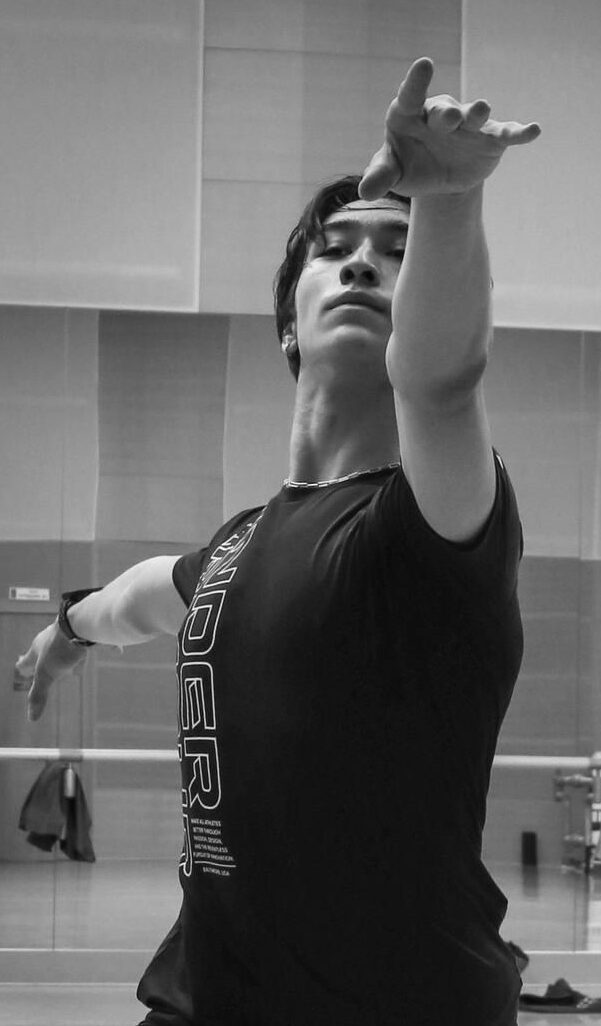
I didn’t really feel the difference, because almost all the teachers there are from Russia. The methodology there is also Russian. My teacher was Dmitry Valerievich Magitov from Kiev, who studied at MSU. I’ve known him for a long time because when I was at YAGP the first time, he said he wanted me to join the Cranko school, but he couldn’t issue an official invitation himself, since he’s not the director.
I’m very glad I studied with him. He loved me. I really wanted to work with him at Cranko, and thank God it worked out.
Given your international experience, you could probably have joined the theatre in Belarus, or go to Japan or even somewhere in Europe. Why did you decide to join to the Mariinsky Theatre?
First of all, I like it here more than the Bolshoi Theater or the Paris Opera. I love the Mariinsky repertoire. The Bolshoi has a good repertoire too, but it’s not for me yet. I watched a Gala Concert in Japan in 2022 at the Tokyo International Ballet Festival. They had the Balcony scene adagio from “Romeo and Juliet” with Vladimir Shklyarov and Olga Smirnova. There were many more stars there, but I don’t remember much except Romeo. I felt I needed to go back to where Shklyarov came from to become like him. I like the way he feels the stage and how he plays the role, everything is natural, there is no awkwardness. I honestly remember only him. They were selling recordings of the concert because it was during Covid and I successfully bought videos of this performance. I met him only 2 times in my life, a gala concert in Minsk and also in St. Petersburg, I was his fan. I still watch his recordings when I’m preparing a new role. I immediately took Shklyarov’s recording when I started to learn “La Bayadere” [Editor’s note: Rioma debuted as Solor with the Mariinsky in late July 2026]. His steps are universal. He performs Romeo, the Hooligan, various Princes, although they’re all completely different roles. And he can act, it’s all natural. Even via the recording, it’s clear he enjoys the stage and his partner.
 The famous Mariinsky dancer Leonid Sarafanov was a principal for years with the Mikailovsky and then directed the Novosibirsk troupe for about 3 years. He’s now your pedagogue. What is it like to work with him?
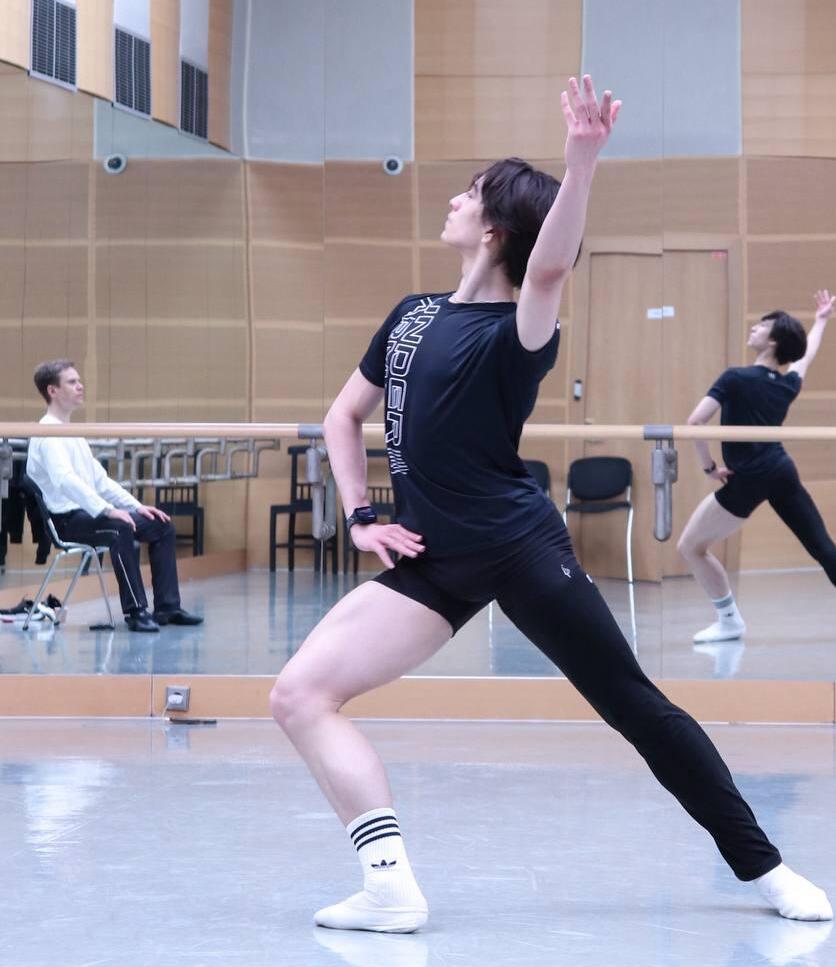
I’d describe him as free; he never minds if I change a step combination, and vice versa, he wants to be different from others. Not to radically change everything –you can’t do that in the classics– but within the framework of the classics. He doesn’t want just the usual combinations. He always wants us to add our own style. He takes the approach of creating an original, natural result. In Minsk, my teacher was quite old, he went by the book so to speak, his methodology was old, and I was not particularly interested in that. There’s a different approach here.
How do you determine what to change and how much?
It’s hard to say, but I’ll suggest a combination that I have in my head, and if he likes it, then he will watch it. Then I’ll show what I’m going to do to another pedagogue. We make sure it doesn’t look strange or crooked. If it’s for a gala concert, then you can do just about anything if you only have a duet. But if it’s a performance, a production, then the corps de ballet is standing there, they can’t move, and you have to take that into account. The difference from the original should not be huge. We sometimes joke about the Bolshoi Theatre, how they change a lot of the choreography to other jumps. Here, the audience won’t applaud if we do that.
The audience there, Muscovites, love that, they have a different style. It’s not bad, but it’s different, and you can’t do that here. We will not change the whole variation.
For those who study with Leonid Dmitrievich [Sarafanov], we have the freedom to choose how to adapt the variation to ourselves. Not all pedagogues are like that. A lot also depends on the dancer. I have a more explosive technique. Alexei Orokhovsky also studies with Sarafanov and he has a more classical, slightly more assembled style of saut de basques and revoltades. And although we have the same coach, Sarafanov’s approach to each of us is different.
 Do you also work on pantomime with Sarafanov?
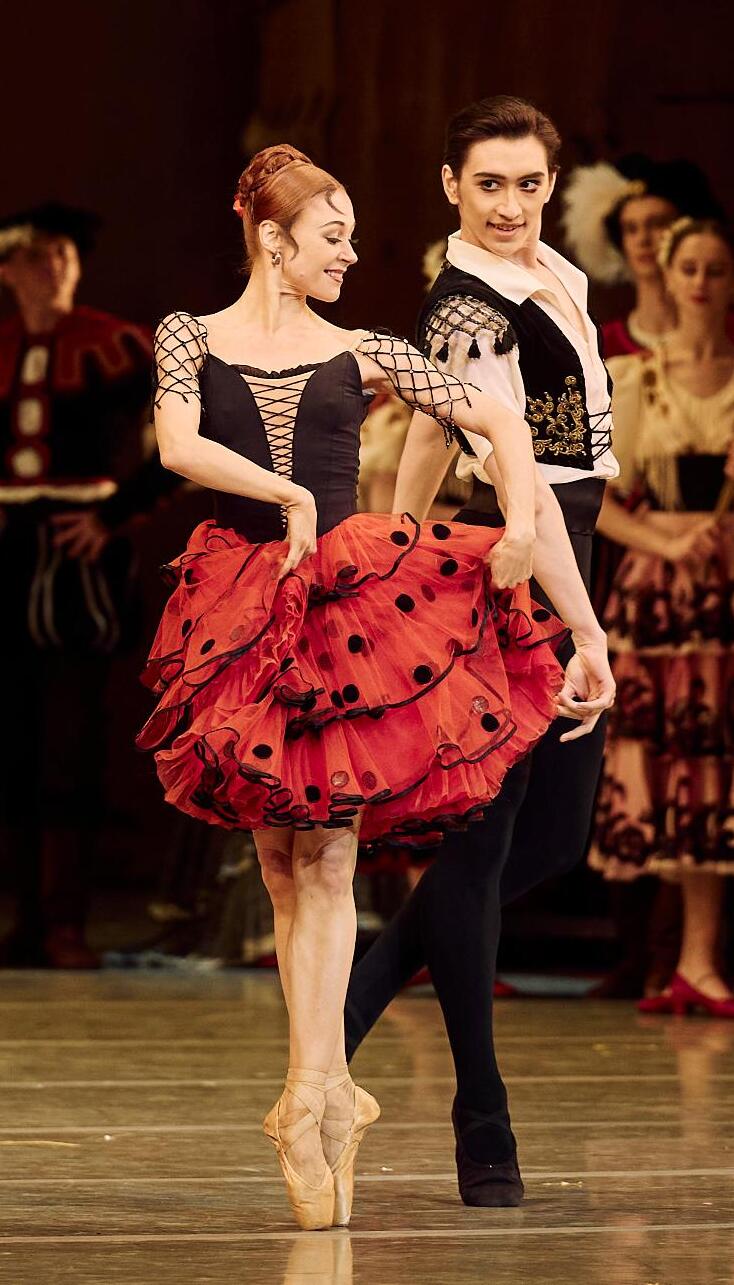
Yes, we didn’t have acting classes at Cranko, we didn’t even have folk dancing. There was a flamenco lesson. Of course, it helped, but I didn’t particularly like it. There were castanets too. But the score is different in flamenco, the pace is sharp and fast. I was always late for that class. I wanted to study acting so that it would be easier in the theater later. But they just didn’t have that class. So I have to learn acting on my own.
For example, the third act in “Don Quixote” has an important acting passage at the start, and it’s difficult. Thank God, I can work with Leonid Dmitrievich. He has strong acting talent, he has helped me a lot. We schedule some rehearsals just for mise-en-scène and acting moments, so as not to go on stage and do it for the first time, and not just to rehearse a variation. So sometimes if I’m tired we can use the rehearsal time to work on the character.
What was your impression of the theatre when you first came here?
I felt freer, I had no doubts or thoughts such as, “I won’t be able to dance here.” Even while auditioning, I could imagine myself here, spending my life here. I like the atmosphere on the historical stage, even without performances, you can look into that empty auditorium forever, it’s so beautiful. M2 is new, but not as amazing. The historical stage is special.
Do you have any rituals or routines before going on stage?
I don’t do anything special because I don’t want to end up in a position where suddenly I can’t do it, and then the performance doesn’t work out. It’s better not to panic before going on stage. I just do fifth position and extensions before going on stage. Of course, I stretch before the performance, but not right before going on stage. Just fifth position to get ready.
What’s the most difficult part of your job?
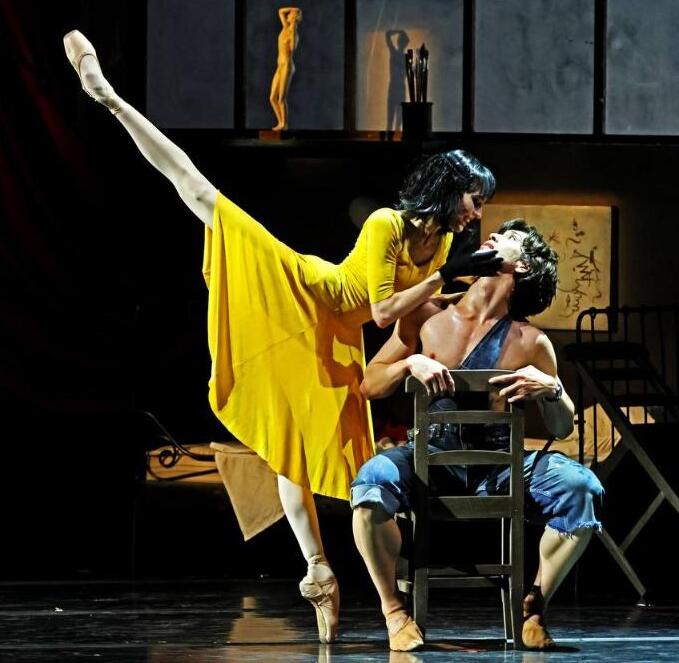
Acting or duet. New roles are also difficult. We recently performed “The Young Man and Death,” and I presumed experienced dancers like Sasha Sergeev or Kostya Zverev would dance it, but we were rehearsing it. It was difficult with the chairs, tables, and a bed. Plus, we didn’t rehearse with any music. I was sick for the first rehearsal, I only came to the third, and Luigi said to me, “Where are the cigarettes? You need to smoke real cigarettes on stage.” He explained to me how to smoke. I’ve never smoked before in my life! Imagine, I’m 20 years old and I learned to smoke cigarettes inside the Mariinsky Theatre! It’s part of the job in the production, that’s how they danced it, and still do it that way.
You weren’t allowed to listen to the music beforehand because Roland Petit arranged it on purpose so that dancers wouldn’t hear it. He changed the music several times before the premiere. But you need to know the music so that you can match the score and not dance the last part in silence, without music. He forbade me to hear the music so that I could create my own tempo with my partner. We only had 3 or 4 rehearsals with the orchestra, and I did the rest without music. Of course, it’s difficult to not be late with the music. If you’re late, you’ll have a minute and a half of dancing without music, and that’s a big problem. That happened when Shklyarov was dancing with Kondaurova, there’s a recording where the orchestra played to the very end, finished the music, and then the dancers continued the choreography to the end without music.
The easiest part of my job is dancing solo parts.
 You recently participated in the 2026 International Ballet Competition in Moscow and won a gold medal in the senior group. Congratulations on winning! I’d like to ask, since you’re already dancing professionally, what does the competition give you and why did you need it?
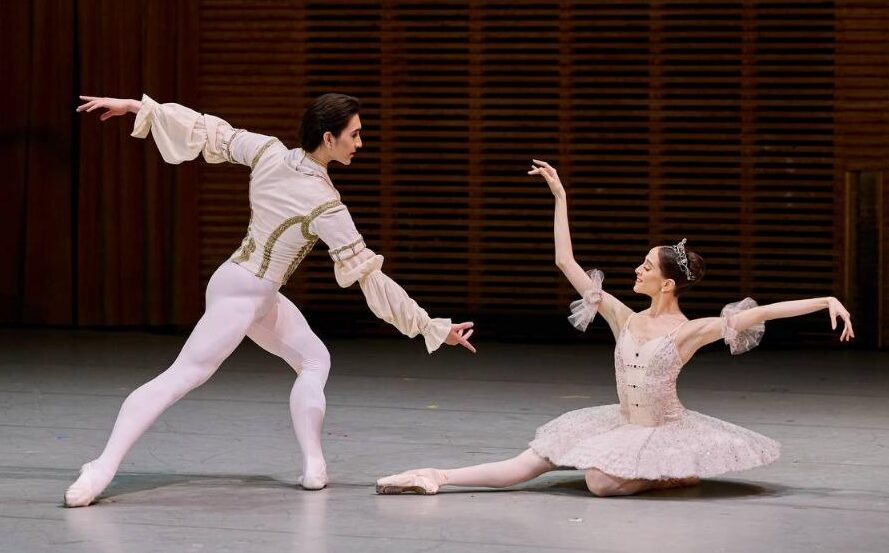
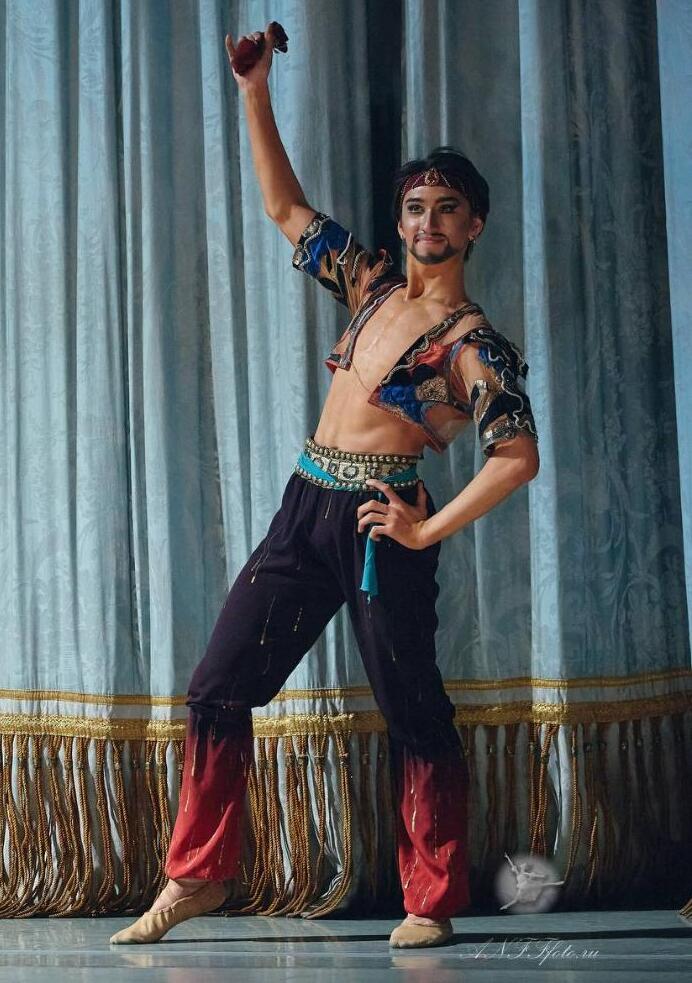
First, I was generally unhappy with the silver medal in 2022 and wanted to win the gold. I discussed it with my parents. I obtained experience from the competition the first time around, it helped me feel more stable and see where I stand among my colleagues. I came to the Mariinsky in my first season and immediately asked Andrian Gurievich [Fadeyev] if I could participate in the competition in 2026, because I wanted to show him and the jury that I could dance not only my strong parts — Lankedem, Ali, Basilio — but also Prince Desiré and Jean de Brien in “Raymonda”. That’s why I specifically chose “Sleeping Beauty” for the competition. I don’t know how much of a mistake it was, but it’s good that I danced it. I rehearsed it with Leonid Sarafanov, he was beautiful as Prince Desiré. During the application process, 7 dance numbers had to be selected. I wanted to dance the princes, whom I may never dance at the Mariinsky. It seemed to me that Andrian Gurievich does not see me as a prince. They, the management and the pedagogues, know that I can dance strong roles. But I wanted to show them that I can also dance in white tights, and set goals for myself to be better in the future.
At first, Leonid Dmitrievich refused. First, because he thought that it wouldn’t suit me, and second, because this is a variation where mistakes are immediately visible. Blurry princes are not interesting to anyone. When I submitted the application, I just put “Sleeping Beauty” on it, and didn’t say anything. I informed him after the fact. Otherwise, it would have been a waste for me to rehearse it for a month and not perform it. I thought I was going to get silver again. I didn’t expect a gold medal! Akib, who performed from the Bolshoi, danced very well, he has a strong technique.
Would you like to dance in “The Sleeping Beauty” here?
I want to dance everything here: princes, Desiré, Romeo, and if it returns to the repertoire, then Balanchine — “Symphony in C Major”, “Jewels”.
Were you nervous during the competition?
During the second round, yes. The first and third – no. I know I have a tendency to get nervous before Basilio’s variation. I’ve danced it several times in Japan, and my hands always shake before that variation. I don’t know why. It only happens in that ballet.
 When you came to the theatre, what was the atmosphere like?
I wasn’t particularly nervous. We had to gather a lot of documents, so for the first month there was no free time. It was good to go to class, because either Yuri Fateev or Leonid Sarafanov teaches us. I can choose who to study with.
Is there competition between colleagues?
No, we just don’t have time for that. There’s a huge repertoire, and there is no time to look at others and judge. Everyone is kind and helpful. They give advice and their opinion about your performances.
Do you do cross-training?
I’m constantly stretching, I can’t avoid it: before and after class, before and after rehearsals, before going to bed. Always. It’s probably a good thing, but I think about how much time it takes, and I imagine how much more I could sleep if I didn’t do it! Another thing is I get a massage at least once a week to restore the body. Self-massage, when you do it to yourself, does not count. We need a special massage therapist.
How do you relax?
Either I go for a walk with a friend, or to the sauna, or out of town, although we don’t have much time for that. I love staying at home and letting my body restore itself. I’ll go for a massage or cook a meal: steak or meat, sometimes soup, chicken. Healthy food for the body. I rest when I can. At the end of the season, you need to be careful not to get injured. Sometimes I watch anime, movies or listen to music.
Do your parents attend your performances?
They’re still in Japan, but I film my rehearsals and send them to get ideas so other eyes can look at me too.
What advice would you give to young people?
If you enjoy dancing, it’s good. But you also have to prepare yourself. Learn and correct your mistakes.
Do you have any dreams?
To become a principal dancer and Honored Artist of Russia! I dream that my body won’t hurt. The fewer injuries, the better. I would like to dance a big repertoire and to dance forever.
Photos all from Ryoma’s personal archive, including works (c) Mariinsky Theatre by Mikhail Vilchuk and Natalia Razina. Studio shots by Yulia Kuzmina.