 “Le Corsaire”, the ballet most known for swashbuckling pirates awash from a shipwreck and the fairytale princesses that save them, is one of the true jewels in the Mariinsky repertoire. Its origins stem as far back as 1863 when it premiered in Saint Petersburg, but it wasn’t until 1987 that the ballet took its current form under Pyotr Gusev and Teymuraz Murvanidze. After what seemed like a long summer break the company returned in top form the first week in September, and following a packed “Romeo and Juliet”, it presented two performances of this audience favorite to full houses.
“Corsaire” is an apt choice for both young and old alike. Turbulent seas tossing a wooden pirate ship in stormy weather appear when the curtain rises, and we see the pirate Conrad and his slave-helper Ali jump overboard in an attempt to avoid sinking. A group of Greek maidens are dancing on the shore and they save the brash young men –Medora and Conrad of course immediately fall in love– but Turkish soldiers quickly capture the ladies and take them to market to be sold as slaves. Thus the start of the libretto provides several conflicts at once: how can the new lovers reunite, and how can the girls be freed.
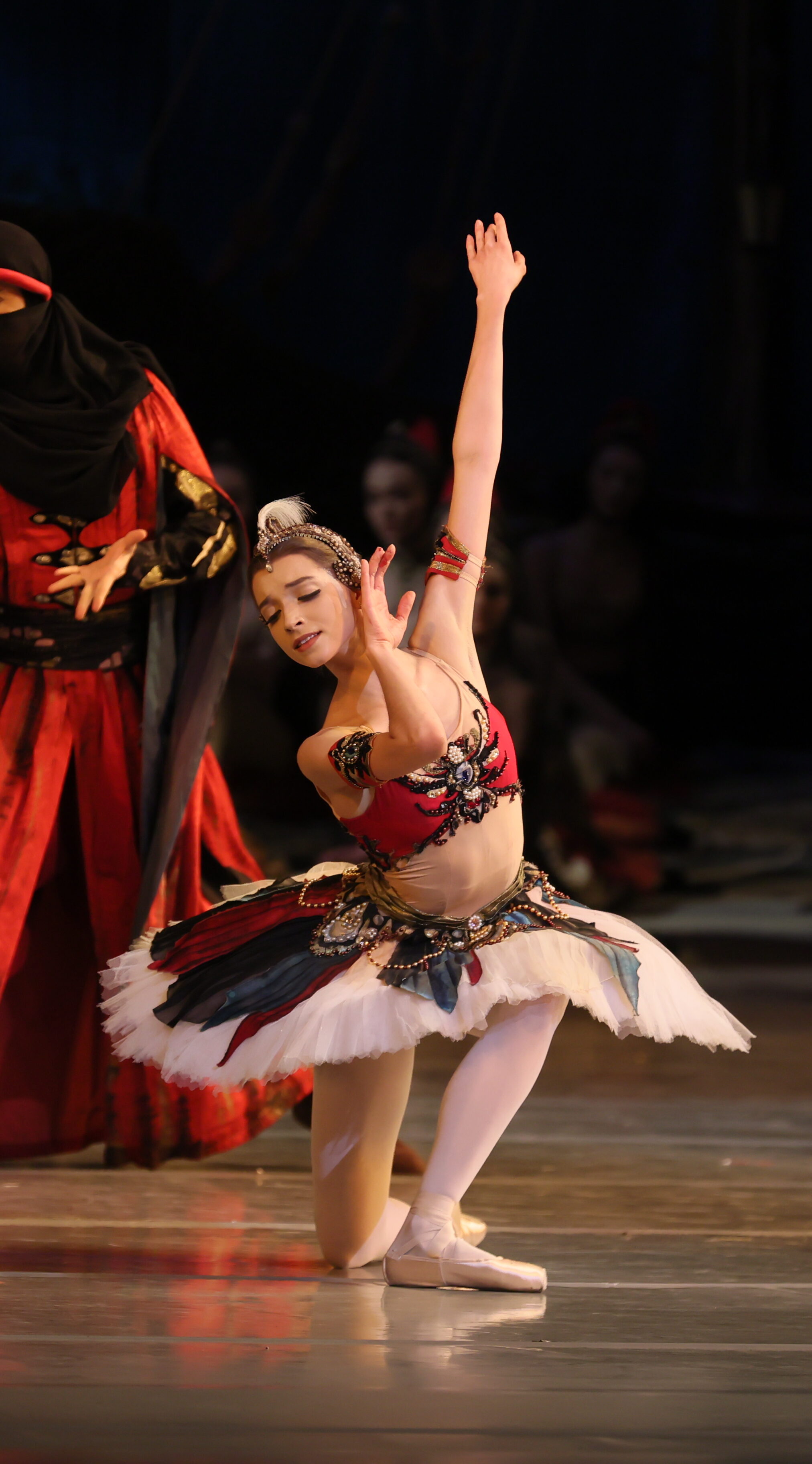
In the matinee, Nikita Korneev portrayed the intrepid pirate Conrad consumed with attraction for Medora. Twisting his mustache and dancing with swords, he combined valiant masculinity with subtle humor. The role is one he easily slides into dramatically; technically, lifts and jumps seem no challenge for his professionalism. His Medora, danced with expert technical and dramatic flair by rising star Maria Bulanova, continues to grow as both a dancer and actress. She appears tenderly smitten in the scene with the wine goblets, and rightfully scared the second he is poisoned by the flowers from Birbanto. Her fouette sequence as always drew applause from the far reaches of the house: a turn in a la seconde, stepping into a quadrouple pique and then a triple fouette, repeated four times. No one in the company can turn like Bulanova, it is her strong suit and perhaps even the ace up this ballerina’s sleeve.
But the fireworks did not stop there. The classical grace of Alisa Barinova is impossible to ignore. If Bulanova is a powerhouse, Barinova is a delicate rose. This lovely ballerina executes every step with technical perfection while endowing the dance with lightness, tenderness and precision. 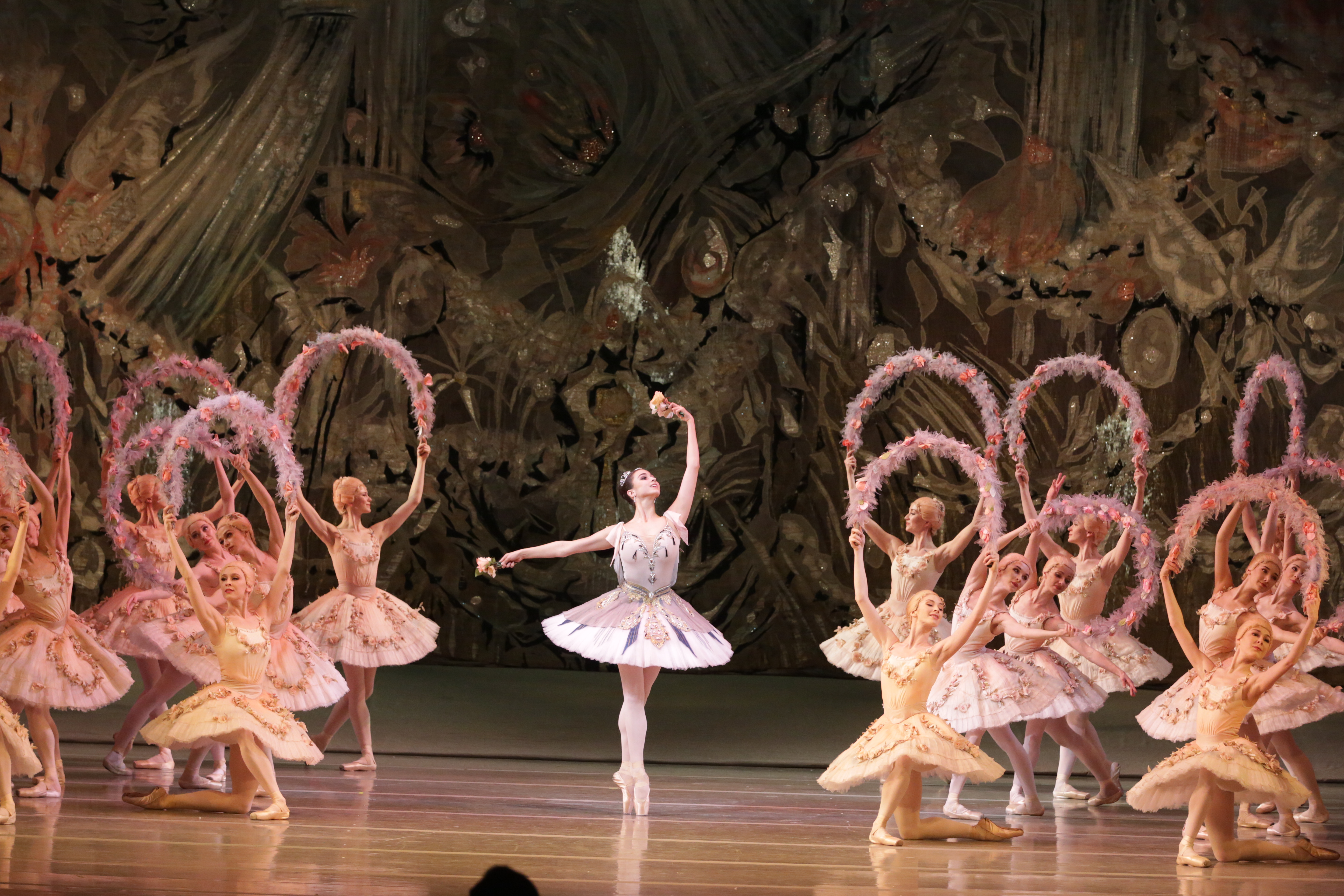 She’s a gracious beauty with long legs and lovely arches who adheres to the canon of Vaganova classicism with taste. Her epaulement extends from her torso not just her neck, her port de bras are always perfectly placed; intricate footwork shows the utmost attention to detail in bourrees and interim steps; and even her eyes serve as a method of expression. In terms of dramatic expression, her Gulnara is ecstatic when reunited in the harem with Medora, and convinced, with half-hidden smirks, that the draped monks are likely pirate saviors come to the rescue. Barinova performed Gulnara in 2023 while still a student, but today fills the role with mature professionalism. She has already been entrusted with significant solo roles and has that rare ballerina quality that is difficult to find. It’s as if she is a noble princess from a bygone era, somehow living amongst us. One hopes she will be featured even more in the future, for she has everything needed to become a prima here.
The winner of the 2026 Moscow Ballet Competition, Men’s gold, Rioma Gudzheleu, performed all manner of pyrotechnic jumps as Ali. Watching him in this role, it’s easy to see why he is a medalist. His ability to take off reveals a force that ensures both power and flight in the air. Crisp turns in second, and a full energetic output accompanied all of his solo work. In our interview he described Ali as one of his “strong roles” and it is no wonder why. He carries it off as if it is second nature.
Although “Corsaire” has a dramatic plot, plenty of humorous moments fill out this libretto: the slave trader Lankedem, performed by Maxim Izmestiev, is a shifty but optimistic character always looking for a better deal, but also highly appreciative of the female beauties he is trying to sell to the harem leader Seid Pasha and other competing buyers. Izmestiev portrays the role with clear levels of pantomime: constant gestures indicating the attractive faces and figures of his ladies –and thus their increasingly high cost– are funny in their hyperbolic persuasive tactics. 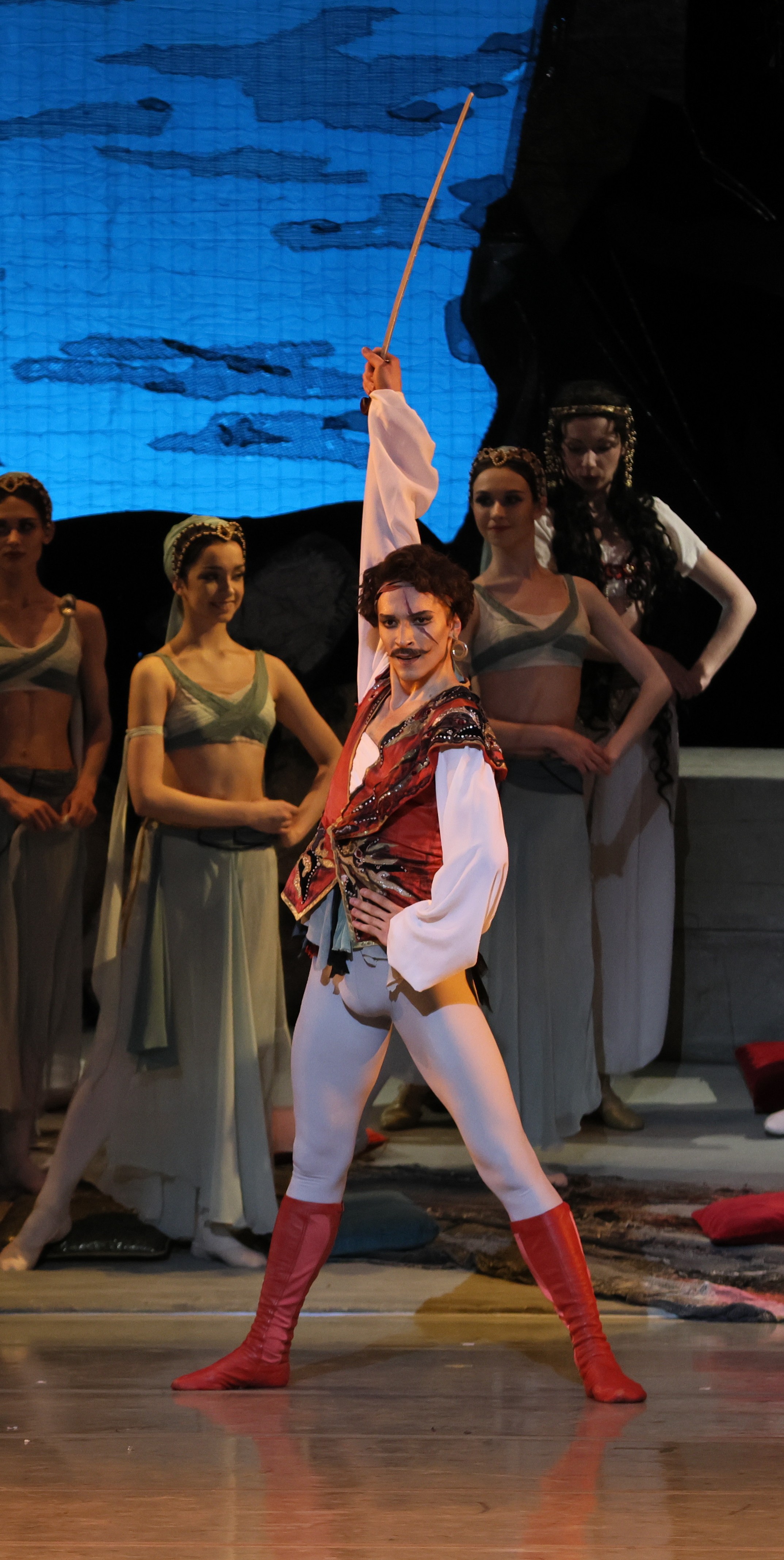
Izmestiev is another one blessed with jumping ability that exceeds many of his peers. He managed to alter the slave trading scene variation to insert some featured jumps that soar high across the stage and never fail to impress. What is more spectacular though is his timing, be it in the acting moments or in the delivery of his jump. Izmestiev’s pulse is on the musicality of the character, and within the moments provided by the score, he creates an entire world with room to spare.
It’s impossible not to mention the supreme acting prowess of Nail Enikeev, who fulfills any character-acting role with just the right amount of spice. His Birbanto, aside from handling the guns and knives with expert skill, proved a fiery, impertinent, somewhat dim-witted (in that lies the humor) yet technically stunning pirate, intent on keeping the young maidens in their cave, rather than letting them return to their villages. He sails across the stage in cabrioles with the pistols, lifting pirate woman Alica Rusina high overhead with ease, and accents every musical crescendo with gusto. Enikeev can bring the energy onstage up several notches just by his presence, always adding an extra level of excitement for the viewers.
The Odalisque trio is a centerpiece of “Corsaire” and Polina Parfenova, Anastasia Lukina and Veselina Ilieva danced it with apt professionalism. It was Ilieva, in the third variation, who completed a set of triple then double pirouettes in the requisite diagonal, drawing attention not just to her turning ability but her musicality.
_ _ _
The photographs shown here are all (c) Mariinsky Theatre.
From above, Alisa Barinova as Gulnara in Act 1 of “Le Corsaire” by Alexander Neff (2026). Maria Bulanova as Medora in “Le Corsaire” by Natasha Razina (2026). Nail Enikeev as Birbanto in “Le Corsaire” by Natasha Razina (2026).