 “Raymonda” seems to be an exclusively Russian ballet phenomenon, performed rarely, if at all, in the West. The first time one views the Mariinsky classic, it seems almost old-fashioned, but considering its conception stems from 1898 and its setting is France during the crusades, it’s appropriate that stone castles and armored crusaders use rudimentary methods to achieve peace and win the princess – and in fact that’s what the libretto is about. But it can be confusing in its mixture of styles and cultures. Rene de Brienne, a Hungarian count, has brought his son Jeanne as a potential suitor and husband for Raymonda, the French princess. But the Saracen Sheikh Abderakhman also wants to marry her…at any cost. Since the ballet is a fairy tale of sorts, of course Jeanne wins, but only after a sword fight in which he knocks off Abderakhman’s turban, slicing his head, and ultimately killing him. Raymonda is overjoyed, crowns her new fiancé, and the last act is their wedding, replete with plenty of Hungarian style dancing.
This ballet can go years without being seen on the Mariinsky stage, and such was the case decades ago. This year, the theatre offered two separate blocks of “Raymonda”, one in May and another in early June. The second block had scheduled the young prima ballerina Maria Iliushkina with her regular onstage partner (who happens to be French by descent, an appropriate casting choice), Even Capitaine as Jeanne de Brienne. Unfortunately, in the aftermath of the passing of Iliushkina’s longtime coach and teacher, former Kirov Ballet prima and People’s Artist Liubov Kunakova, just days before the performance Iliushkina sustained an injury and had to step out of the run. Capitaine remained and prima ballerina Ekaterina Kondaurova performed the role of Raymonda with him.
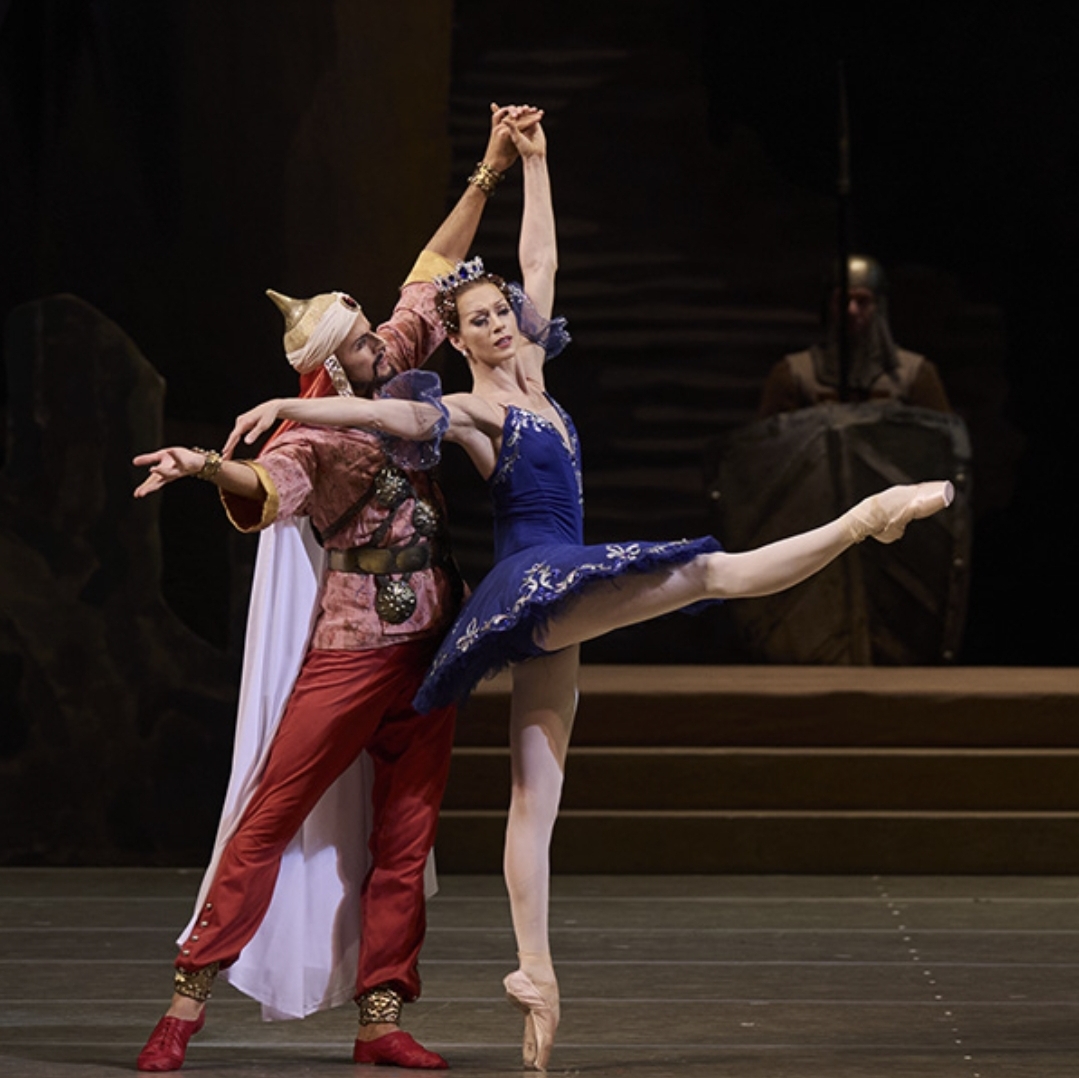 Shifting partners last minute always poses particular challenges, partly because rehearsal time is minimal at best, and adapting to new approaches, physiques and habits requires the one thing that Mariinsky dancers are shortest on these days: preparation time. Yet despite these challenges, both Kondaurova and Capitaine brought this Petipa classic to life in front of a packed audience on Friday June 6th.
With two decades performing with the Mariinsky already behind her, Kondaurova is as beautiful now as she was at the start, still executing the most technical sequences with an ease that’s rare among professionals. The blue-eyed redhead exudes royal blood in this role, and has her own following. The audience immediately welcomed her with applause at her first entrance on stage, as her tiara and pale beige tutu sparkled under the spectacular onstage lighting. Petipa’s choreography here etches the theme of the crusades in movement form: crosses, retiré passés, promenades, arms crossed in front, and the signature lifts done with ballerinas kneeling on her partner’s shoulder, a balancing act in ballet if ever there were one. Despite the awkward combination of certain step sequences, Kondaurova utilized the score’s expansive possibilities –Glazunov’s music is an incredible salve for the ears– to perform them with ease, speeding up some of the more complicated sequences, and slowing down to emphasize her regal position in some portions of the final act.
Capitaine, steadfast in his attentive partnering and sturdy in approach, is to be commended for not just staying the course but sailing through his short variation with equal regality and an image of princely pride. Even if he does not partner Kondaurova often, together the couple found common ground in the music and characterization of their respective roles.
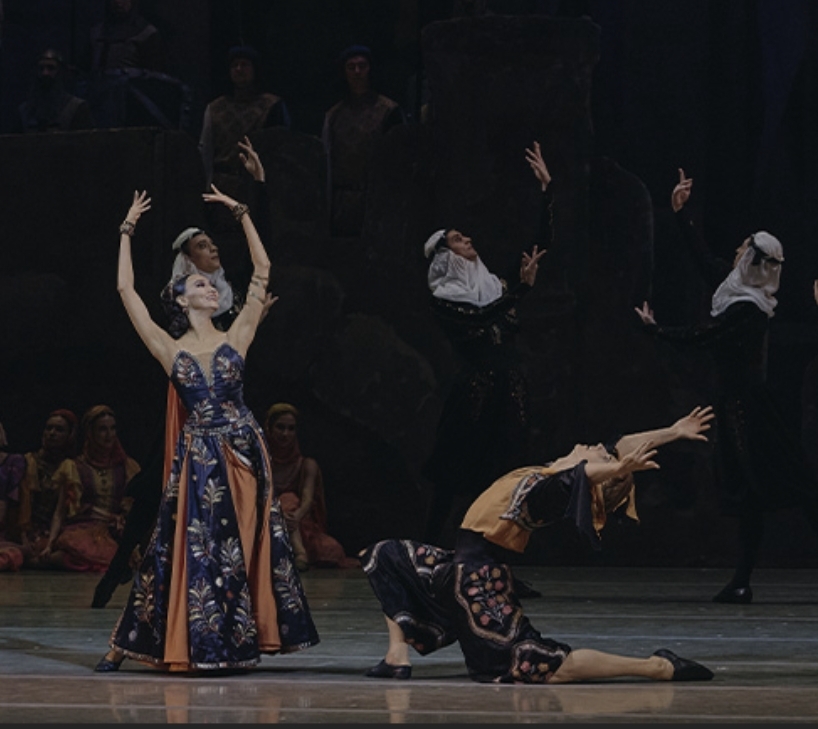 “Raymonda” is a multi-layered ballet, with everything from character dancing to classical, ensemble sections, duets, quartets and trios. Both Camilla Mazzi as Clemence and Alisa Barinova as Henrietta joined Kondaurova as her ladies-in-waiting throughout the evening, both lending a delicacy and precision to their dancing that highlights the contrast between the female traits depicted in the ballet, and the male. Mazzi and Barinova dance for Raymonda in her private chambers and also perform their own variations. The three join hands –an almost lattice-like image– for quick pointe work at several moments, as if purposely distracting themselves from the aggressive behavior of Abderakhman. And as that hated antagonist, Evgeny Deryabin performed the forceful Abderakhman with broad gestures and an utter ignorance of the refinement required in a court setting. His destructive desires led to his demise of course, but it’s to his credit that he made the repulsive character a believable one.
And then there are the celebratory dances: the gold medal, if there were one, would clearly be given to Nail Enikeev with Evgenia Savkina for the Panaderos performed with panache and fire. The corps de ballet dancers who performed in both the Hungarian dance and the Mazurka brought beautiful unison to the stage. The absolute highlight of Act III though is the male quartet, which featured Ivan Sotnikov, Khali Mardini, Danil Zinoviev and Akim Bakaev. This is a musical section that can be listened to even without dancing, but these four had clearly rehearsed the sets of double tours done in cannon, and their hard work paid off.
Longtime expert Valeriy Ovsyannikov conducted, and we hope the glory of “Raymonda” will not be long absent from the historical stage.