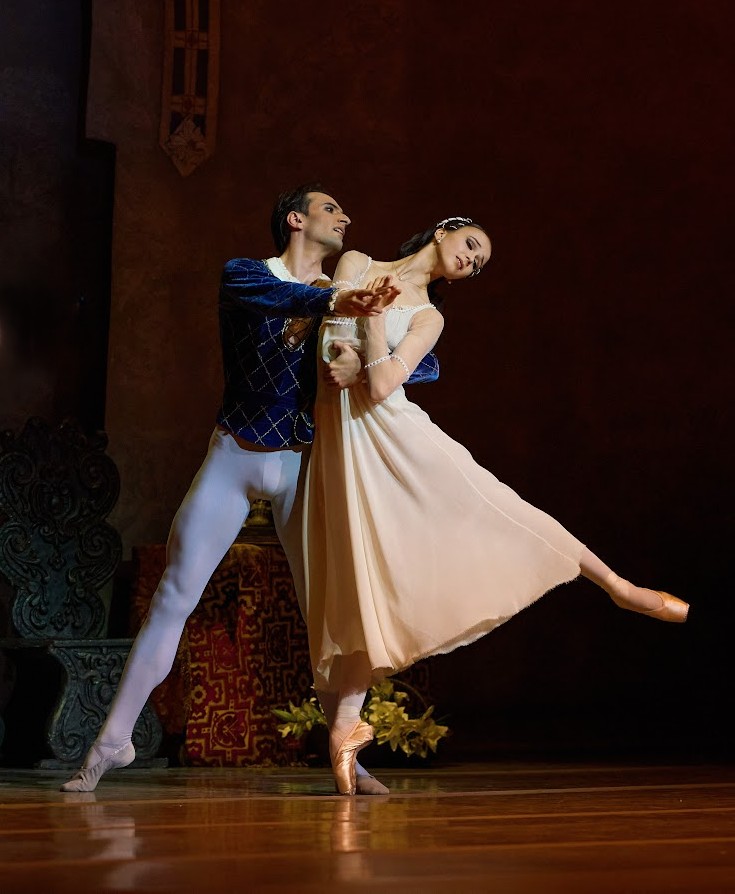
 The sign of a fantastic performance is the energy it leaves behind, hours and days afterward. The matinee of “Romeo and Juliet” on the 22nd of November at the Mariinsky was one such performance, as it continues to resonate even weeks later. Prima ballerina Maria Iliushkina joined soloist Even Capitaine alongside a virtually hand-picked superstar lineup, where each dancer seemed to perform roles made just for them.
In Lavrovsky’s “Romeo”, the version that the Mariinsky runs, we meet the hero first. The handsome, stately (here curly-haired) and dreamy-eyed Capitaine ran on stage greeting the new day with innocent expectation. The proverbial calm before the storm makes it seem, at first glance, as if the world is right side up. The tavern opens for the day as townspeople meander into the square. But hints at coming adversity already exist when warring factions first tease, then egg each other on to fight. Capitaine’s entrance and very presence is the antidote to this. His calm demeanor, honest intent and clear priorities place peace and love above all else. Each time two swords meet mid-air, it is he who pushes them apart. Unfortunately later he loses this battle, but Capitaine portrayed the hero excellently from the start. He has grown considerably in terms of technique in recent years – others have remarked his lines look longer, feet more stretched, and this is unquestionably true– but it’s his acting that truly draws attention. From what previously were conservative dramatic displays to a total emanation of onstage passion, we see the magnetism he feels when he first sets eyes on Juliet, and we also feel his heartwrenching loss when Benvolio arrives with the bad news. This soloist has managed to polish the role and has now made it his own.
Soloist Nail Enikeev performed the bloodthirsty, scorn-driven, hateful (in truth the myriad of adjectives that fit him are nearly endless) Tybalt, a seemingly unfeeling villain who chomps at the bit for any chance to fight. Having witnessed numerous Tybalts at the Mariinsky, it’s safe to say that Enikeev raises the battle between good and evil to an art form. He may easily be the sole dancer in the troupe who becomes Tybalt rather than just acting him. Enikeev’s initial encounter with Romeo shows his impetuous side: he jumps forward ready to stab the newcomer at his  sister’s birthday gathering and only his father can force him to back off. After stabbing Mercutio, glee spreads across Enikeev-Tybalt’s face, as he mocks Mercutio’s finger gestures in slow motion, a gemstone ring gleaming on his hand in the process, as if highlighting the victory; he then toasts with the “cup” portion of his sword, sipping imaginary celebratory champagne which underscores how much he enjoys being bad. Before Romeo stabs him, Enikeev smacks his lips, his eyes darkly gleaming, desiring more of the fight. Enikeev’s character is a man hell-bent on conflict who pays with his life for it. Enikeev’s interpretation is genius, filled with powerful nuance and high energy that few can match. His Tybalt is not just one to watch, it is one for the history books on ballet’s best.
One cannot mention Romeo and Tybalt without mentioning, of course, Mercutio. The light-hearted and playful Maxim Izmestiev, whose real-life personality has a dash of that same comical nature, is lovable to the very end in this role. As one of the troupe’s resident jumpers, Izmestiev easily pulls off any type of airborne feat. Thus the exhausting Mercutio variation suits him, for he attacks it with unbridled vigor. It’s easy to feel Romeo’s sorrow when this Mercutio dies, because Izmestiev easily endears himself to any audience.
There can be no more appropriate Juliet this year than that of Maria Iliushkina. Not because she is an endlessly light, lithe and beautiful ballerina, and not because she is also a consummate dramatic actress in her own right, at least as witnessed by this spectacular performance– although all that is true. Iliushkina has both the technical and dramatic sides of the talent coin, and that’s all on full display in her Juliet. But perhaps because she and Capitaine are newlyweds themselves as of this year, their duet brimmed with tender love, determined devotion, and the associated heart-wrenching loss at the end of this tale. At her first entrance, she embodied a playful almost childlike Juliet, filling each jeté with abandon and joy, as if the last vestiges of childhood escaped through those very steps. For in the next scene, her birthday, she was already a young lady receiving toasts at a banquet, dancing demurely, proud to be recognized but unaware of the sweeping changes about to take place in her life.
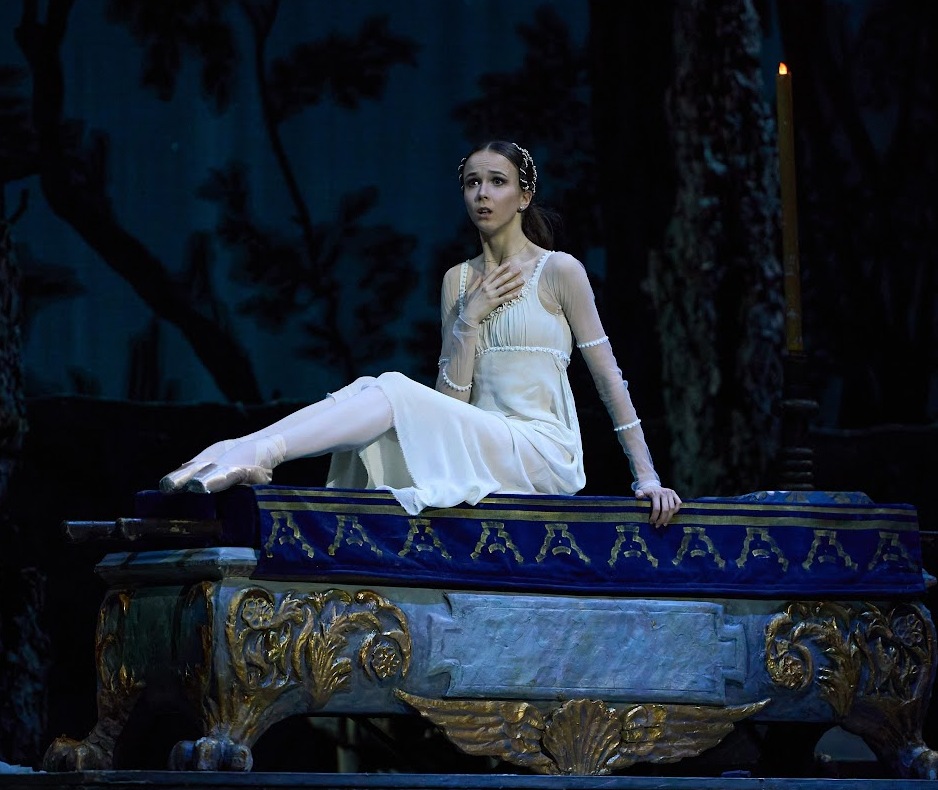
Iliushkina added dramatic detail in the bedroom scene with her parents. Instead of going through the proverbial choreographic motions as many do in this section, she physically pleaded first with her father, then with her mother and finally her nurse. Her eyes, posture and gestures all melded into an appeal for mercy that the libretto does not provide. Seeing their immobile stances, she became impertinent, suddenly a histrionic teenager –from their viewpoint– that
 no one understands. It’s at this point that we see the nonsensical nature of Juliet’s world through her own eyes. Those closest to her appear cold and dysfunctional, placing position and duty above feeling and truth. Her violent father, played by Nikolai Naumov, and self-indulgent mother, Alexandra Iosifidi, form a veritable barrier which she cunningly agrees to only after she has the “magic” potion in hand. But her attempted duet with Paris, played by the staud and handsome Alexander Belonorodov, fails; she begins their duet with tears welling up in her eyes, her gaze directed far away where Romeo may be, her arms stretched to the balcony he just exited. Moments later, her refusal to provide Paris with a kiss leads to his clearly expressed indignance and sudden departure from the room.
Iliushkina is one of the youngest primas in the troupe, but her Juliet is by far one of the most mature and most polished. Along with Capitaine, this duo are creating a poignant onstage duet that is also one for the history books.
Rioma Gudzheleu debuted in this performance as the red bereted Troubador alongside the lovely Vlada Borodulina. Gudzheleu’s natural ballon stands out. His soaring jumps seemed contained by this choreography, as if a caged tiger needed more space to move, but his grace smoothed over the gap, tapering the dance to the choreographic framework. Borodulina displayed lyrical arabesques, ease in duet work, and a lightness that implies more solo roles ahead.
Boris Gruzin conducted the masterfully melodious Mariinsky orchestra in this gorgeous Prokofiev score.
Photos by Alexander Neff (2025) (c) Mariinsky Theatre. From top: Maria Iliushkina and Even Capitaine; Nail Enikeev as Tybalt; Maria Iliushkina in Act 3; Maxim Izmestiev as Mercutio. The image of Maxim Izmestiev was taken in 2023 by Alexander Neff (c) Mariinsky Theatre.