 The ability to give 110% to a performance even amidst the more challenging sides of the ballet profession — overwork, urgent rehearsals, injury, fatigue — is one sign of true artists, those who place dedication above personal preference and infuse sheer grit into the process when perhaps not much else is left. While far from a desirable situation (for safety reasons, if nothing less), sometimes the profession demands just that: determination and strength, mental perhaps more than physical. We always help that those times are few and far between, how much easier ballet would be if casting were always evenly distributed, opportunity plentiful, time more forgiving, and injury absent. Theatre life however, is not this way. On May 23rd, a top level “Bayadere” cast graced the Mariinsky stage with true art. Yes, it was the usual high-caliber delivery, but against the backdrop of exceptional circumstances, and nonetheless drawing a full hall of faithful viewers and loud applause.
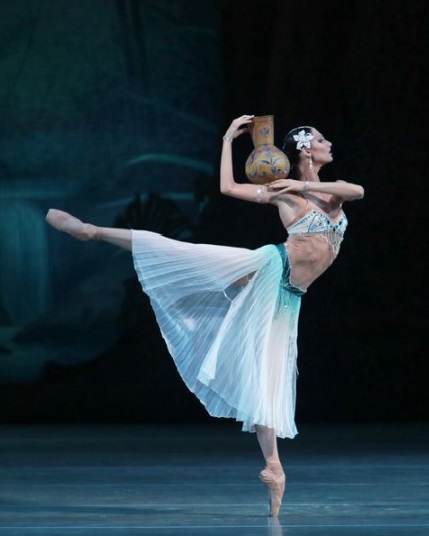 Prima ballerina Oksana Skorik, she of exquisite line and impeccable purity, seemingly rarely cast these days for reasons unknown, reprised Nikiya alongside the reliable, princely Nikita Korneev who has become, for all intents and purposes, her constant onstage partner for most classical roles. Although presently the Mariinsky sports big name stars such as Kimin Kim and Minchul Jeon, they’re typically paired with other females, and the rest of the male roster is injured or recovering, while rising soloists have not yet had time to rehearse and incorporate major classical roles to their respective repertoires. By means of illustration: the recent 4-performance run of “Stone Flower” had Korneev filling two of the four performances with different ballerinas, he is currently rehearsing “Swan Lake” with Maria Bulanova for her upcoming debut (just 5 days hence), and performed this evening’s Solor in the interim — all of this is a heavy load for one man. Yet Korneev’s perseverance far outweighs whatever might have been required. He displayed strength, dramatic acuity –you truly believed he was overjoyed to see Nikiya– and steely technique: crisp cabrioles in his Act 2 variation led into the circle of double assemblé tours in Act 3, all the while juggling the lifts –and drama– of two very different ladies. The rising soloist deserves recognition for carrying this unreal load with such poised determination. If kudos go to the “last man standing” then, in terms of workload, Korneev is it.
As Nikiya, the long and lithe Skorik moved through Act I’s tender-hearted pride to the wrenching angst of Act 2’s betrayal in a logical, emotional development. Despair quickly shades her face as she gazes into Korneev’s eyes, resolutely tosses the antidote bottle aside, and chooses death rather than the pain of betrayal. Then in Act 3, iconic lines and crystalline musicality make her Shade a vision of ethereal purity.
Bulanova, incredibly, has overcome much on her path to soloist (see our interview with her here). Gamzatti seems an “easy” role for her. First, her dramatic sequences are infused with slight nuance but the effects are far reaching. In Act 2, she so fully transforms into the envious princess, peering deep into Nikiya’s face to plot a victory, that you’re glad you aren’t Nikiya. Second, technically speaking, for her the challenges of the role seem effortless as she executes 16 super sharp Italian fouettés, followed by double regular fouettés that are easily tossed off at supersonic speed. She mentioned in our interview that she loves allegro. When you see her turn, you know why. She relaxes not only in jumps, but in turns. Pirouettes and fouettés are her home turf.
Aaron Oh performed a statuesque Golden Idol in Act I, and the trio of Anastasia Yaromenko, Egor Rachin and Nikita Zakharov lit proverbial fires under the audience with their electric Indian dance in Act II. Arseniy Shuplyakov conducted.
Photos courtesy of the Mariinsky Theatre.